Shipping Goods to China: A Complete Guide for Thai Exporters

The Chinese market is considered one of the most promising markets for Thai exports. With its massive population and continuously growing purchasing power, China is an attractive destination for Thai businesses looking to expand overseas. However,To ChinaExporting goods to China involves strict procedures and regulations. This article will help you understand the export process to China, necessary documents, taxes and fees, as well as tips for marketing your products in China, to ensure the success of your exports.

4 Steps for Exporting to China

The main steps involved in exporting goods to China are as follows:
  1. Preparation:

    • Study the market and select products: Understand the needs of the Chinese market and select products that meet consumer demands.
    • Looking for a buyer: Find potential buyers in China through various channels such as trade shows, online platforms, or distributors.
    • Negotiate: Agree on trade terms such as price, quantity, and payment terms.
  2. Document preparation:

    • Export documents: Prepare the necessary export documents, such as the Export Declaration, Commercial Invoice, Bill of Lading, or Air Waybill.
    • Other documents: Additional documents may be required depending on the type of product and Chinese requirements, such as a Certificate of Origin, Health Certificate, or Import License.
  3. Transportation:

    • Choose your shipping method: Choose the transportation method that best suits your goods and needs, such as sea, air, or land freight.
    • Packaging and labeling: The products were packaged safely and labeled according to Chinese regulations.
  4. Customs clearance procedures:

    • Product declaration: Submit documents and pay taxes and fees related to importation.
    • Customs clearance: Waiting for customs clearance from Chinese officials.Customs procedures

Documents used for exporting to China.

The required documents for exporting goods to China may vary depending on the type of product. However, the basic documents that are usually needed include:
  • Export Declaration
  • Commercial Invoice
  • A bill of lading or an air waybill.
  • Certificate of Origin
  • Health Certificate (for food products)
  • Import License (for certain types of goods)

Taxes and fees for exporting to China.

Exporting goods to China is subject to the following taxes and fees:
  • Value Added Tax (VAT): The value-added tax rate in China is 13% for most goods.
  • Customs duties: Customs duties vary depending on the type of product. These can be checked from the product's HS Code.
  • Other fees: There may be other fees such as customs clearance fees, product inspection fees, or domestic shipping costs within China.

Marketing of products for export to China.

Marketing products in China presents challenges that differ from other markets. Exporters should consider the following strategies.
  • Understanding Chinese consumers: Studying the behavior and needs of Chinese consumers in order to offer products that meet their needs.
  • Use an online platform: China has many popular online platforms such as Tmall, JD.com, and WeChat. Exporters should utilize these platforms to reach consumers.
  • Building a brand: Build a strong and trustworthy brand in the Chinese market.
  • Collaborate with local partners: Find business partners in China to help with marketing and distributing products.

China's import regulations.

China has strict import regulations and requirements. Exporters should study and strictly adhere to these regulations to avoid problems during importation.

Export your goods to China with confidence and without worry with SME Shipping.

SME Shipping provides comprehensive transportation and customs clearance services for exporting goods to China. Our team of experts is ready to advise and assist you at every stage, from document preparation and transportation to customs clearance, ensuring your export process is smooth and successful. Contact us:
  • LINE: @Shipping
  • Tel: 021057777
Don't let the complexities of exporting to China hinder your business. Consult SME Shipping today to start exporting with confidence.

Add your heading text here.

Shipping goods to Korea for Thai exporters.

South Korea is one of the countries with a strong economy and high purchasing power, making it an attractive market for Thai entrepreneurs looking to expand their businesses abroad. Exporting goods to South Korea therefore presents a good opportunity to generate revenue and grow businesses. However,Sending goods to Korea.Exporting goods to South Korea involves strict procedures and requirements. This article will help you understand the export process to South Korea, from preparation and transportation to customs clearance and related trade agreements, ensuring your export is smooth and successful.

Exporting goods to Korea: Procedures and methods.

The main steps involved in exporting goods to Korea are as follows:

  1. Preparation:

    • Study the market and select products: Understanding the needs of the Korean market and selecting products that meet the demands of Korean consumers, as well as studying competitors and market trends, will enable you to develop appropriate marketing strategies.
    • Looking for a buyer: Find potential buyers in Korea through various channels such as trade shows, online platforms, or distributors.
    • Negotiate: Agree on trade terms such as price, quantity, and payment terms.
    • Registration and licensing: Inspect and process applications for licenses related to exporting goods to South Korea.
  2. Document preparation:

    • Export documents: Prepare the necessary export documents, such as the Export Declaration, Commercial Invoice, Bill of Lading, or Air Waybill.
    • Other documents: Additional documents may be required depending on the type of product and Korean requirements, such as a Certificate of Origin, Health Certificate, or documents from the MFDS (Ministry of Food and Drug Safety).
  3. Transportation:

    • Choose your shipping method: Choose the transportation method that best suits your goods and needs, such as sea freight, air freight, or multimodal transport.
    • Packaging and labeling: Package the products safely and label them according to Korean requirements, especially translating the labels into Korean.
  4. Customs clearance procedures:

    • Product declaration: Submit documents and pay taxes and fees related to importation.
    • Customs clearance: Waiting for customs clearance from Korean customs officials, which must be completed.Customs procedures

The trade market between Thailand and Korea: Opportunities and Challenges.

  • chance:

    • South Korea has high purchasing power and is open to imported goods.
    • The popularity of Thai culture and Thai products continues to grow.
    • The ASEAN-Korea Free Trade Agreement (AKFTA) helps reduce trade barriers.
  • The challenge:

    • Competition is high from both domestic and foreign manufacturers.
    • Strict product regulations and standards.
    • Cultural and linguistic differences

Products that are in demand in Korea.

Many Thai products are popular in the Korean market, such as:

  • Food and drinks: Fresh fruit, dried fruit, snacks, condiments, and processed seafood.
  • Fashion items and accessories: Stylish and high-quality clothing, accessories, and shoes.
  • Health and beauty products: Cosmetics, skincare products, and natural supplements.
  • Handicrafts and home decor: Thai handicrafts are unique and exquisite.
  • Electronic products and IT equipment: Mobile phone accessories and gadgets.

Marketing in Korea

Marketing in Korea requires an understanding of Korean consumer behavior and preferences, as well as the use of appropriate marketing channels, such as:

  • Online platform: Naver, Coupang, and Gmarket are the most popular e-commerce platforms in Korea.
  • Social media: Instagram, YouTube, and KakaoTalk are important channels for reaching Korean consumers.
  • Influencers: Collaborating with influencers can help increase brand awareness and credibility.
  • Niche marketing: Understand your target audience and adapt your marketing strategies accordingly.

Trade agreement between Thailand and Korea

The ASEAN-Korea Free Trade Agreement (AKFTA), which came into effect in 2009, has reduced or eliminated import tariffs on many types of goods, making it easier to export products from Thailand to South Korea.

Export your goods to Korea with confidence and without worry with SME Shipping.

SME Shipping provides comprehensive transportation and customs clearance services for exporting goods to Korea. Our team of experts is ready to advise and assist you at every stage, from document preparation and transportation to customs clearance, ensuring your export process is smooth and successful.

Contact us:

  • LINE: @Shipping
  • Tel: 021057777

Don't let the challenges of exporting to Korea hinder your business. Consult SME Shipping today to start exporting confidently and successfully in the Korean market.

Shipping goods to America: A golden opportunity for Thai exporters.

Shipping goods to the USA: A golden opportunity for Thai exporters.

The United States is a large and highly potential export market for a wide variety of Thai products. With its immense purchasing power and diverse demand for goods, the US is an attractive target for Thai entrepreneurs looking to expand their businesses internationally. However,Exporting goods to America.There are strict procedures and requirements that must be followed. This article will help you understand the process of exporting to the United States, from preparation to transportation.Customs proceduresAnd related trade agreements to ensure your exports go smoothly and successfully.

Exporting Goods to the United States: Steps and Processes

The main steps involved in exporting goods to the United States are as follows:

  1. Preparation:

    • Study the market and select products: Understand the needs of the U.S. market and select products that best meet consumer demands.
    • Looking for a buyer: Find potential buyers in the U.S. through various channels such as trade shows, online platforms, or distributors.
    • Negotiate: Agree on trade terms such as price, quantity, and payment terms.
    • Company registration: If company registration in the United States is required, it should be completed beforehand.
  2. Document preparation:

    • Export documents: Prepare the necessary export documents, such as the Export Declaration, Commercial Invoice, Bill of Lading, or Air Waybill.
    • Other documents: Additional documents may be required depending on the type of product and U.S. requirements, such as a Certificate of Origin, Health Certificate, or documents from the FDA (Food and Drug Administration).
  3. Transportation:

    • Choose your shipping method: Choose the transportation method that best suits your goods and needs, such as sea freight, air freight, or multimodal transport.
    • Packaging and labeling: Package goods safely and label them according to U.S. requirements.
  4. Customs clearance procedures:

    • Product declaration: Submit documents and pay taxes and fees related to importation.
    • Customs clearance: Waiting for customs clearance of goods by U.S. Customs officials.

International trade terms and conditions

Exporting goods to the United States requires compliance with various requirements and regulations related to international trade, such as:

  • Free Trade Agreements (FTAs): Thailand and the United States do not have a free trade agreement; therefore, Thai goods exported to the US may be subject to normal import duties.
  • Hygiene and safety regulations: Certain types of products, such as food, medicine, and cosmetics, must comply with U.S. hygiene and safety regulations.
  • Product standards: Certain types of products must comply with U.S. standards, such as electrical or safety standards.

The American export market: Opportunities and challenges.

The US market presents many opportunities for Thai products, but it also faces challenges such as:

  • chance: High purchasing power, diverse demand for goods, and openness to imported products.
  • The challenge: High competition, strict regulations, and cultural differences.

U.S. import tariffs

Goods imported into the United States may be subject to import duties, with rates varying depending on the type of product. You can check the duty rates on the U.S. Harmonized Tariff Schedule (HTS).

Trade agreement between Thailand and the United States.

Currently, Thailand and the United States do not have a free trade agreement, but there is a Thailand-U.S. Economic Cooperation Framework (TIFA) to promote trade and investment cooperation between the two countries.

Export your goods to America with confidence and without worry with SME Shipping.

SME Shipping provides comprehensive shipping and customs clearance services for exporting goods to the USA. Our team of experts is ready to advise and assist you at every stage, from document preparation and transportation to customs clearance, ensuring your export process is smooth and successful.

Contact us:

  • LINE: @Shipping
  • Tel: 021057777

Don't let the complexities of exporting to America hinder your business. Consult SME Shipping today to start exporting with confidence.

Shipping to China: A Complete Guide for Thai Exporters

The Chinese market is considered one of the most promising markets for Thai exports. With its massive population and continuously growing purchasing power, China is an attractive destination for Thai businesses looking to expand overseas. However... Exporting goods to ChinaExporting to China involves strict procedures and regulations that must be followed. This article will help you understand the process, necessary documents, taxes and fees, as well as tips for marketing your products in China, to ensure the success of your exports.

The process of exporting to China.

The main steps involved in exporting goods to China are as follows:

  1. Preparation:

    • Study the market and select products: Understand the needs of the Chinese market and select products that meet consumer demands.
    • Looking for a buyer: Find potential buyers in China through various channels such as trade shows, online platforms, or distributors.
    • Negotiate: Agree on trade terms such as price, quantity, and payment terms.
  2. Document preparation:

    • Export documents: Prepare the necessary export documents, such as the Export Declaration, Commercial Invoice, Bill of Lading, or Air Waybill.
    • Other documents: Additional documents may be required depending on the type of product and Chinese requirements, such as a Certificate of Origin, Health Certificate, or Import License.
  3. Transportation:

    • Choose your shipping method: Choose the transportation method that best suits your goods and needs, such as sea, air, or land freight.
    • Packaging and labeling: The products were packaged safely and labeled according to Chinese regulations.
  4. Customs clearance procedures:

    • Product declaration: Submit documents and pay taxes and fees related to importation.
    • Customs clearance: Waiting for customs clearance.Customs officialsChina

Documents used for exporting to China.

The required documents for exporting goods to China may vary depending on the type of product. However, the basic documents that are usually needed include:

  • Export Declaration
  • Commercial Invoice
  • A bill of lading or an air waybill.
  • Certificate of Origin
  • Health Certificate (for food products)
  • Import License (for certain types of goods)

Taxes and fees for exporting to China.

Exporting goods to China is subject to the following taxes and fees:

  • Value Added Tax (VAT): The value-added tax rate in China is 13% for most goods.
  • Customs duties: Customs duties vary depending on the type of product. These can be checked from the product's HS Code.
  • Other fees: There may be other fees such as customs clearance fees, product inspection fees, or domestic shipping costs within China.

Marketing of products for export to China.

Marketing products in China presents challenges that differ from other markets. Exporters should consider the following strategies.

  • Understanding Chinese consumers: Studying the behavior and needs of Chinese consumers in order to offer products that meet their needs.
  • Use an online platform: China has many popular online platforms such as Tmall, JD.com, and WeChat. Exporters should utilize these platforms to reach consumers.
  • Building a brand: Build a strong and trustworthy brand in the Chinese market.
  • Collaborate with local partners: Find business partners in China to help with marketing and distributing products.

China's import regulations.

China has strict import regulations and requirements. Exporters should study and strictly adhere to these regulations to avoid problems during importation.

Export your goods to China with confidence and without worry with SME Shipping.

SME Shipping provides comprehensive transportation and customs clearance services for exporting goods to China. Our team of experts is ready to advise and assist you at every stage, from document preparation and transportation to customs clearance, ensuring your export process is smooth and successful.

Contact us:

  • LINE: @Shipping
  • Tel: 021057777

Don't let the complexities of exporting to China hinder your business. Consult SME Shipping today to start exporting with confidence.


Shipping goods to Korea for Thai exporters.

South Korea is one of the countries with a strong economy and high purchasing power, making it an attractive market for Thai entrepreneurs looking to expand their businesses overseas. Exporting goods to South Korea presents a great opportunity to generate revenue and grow businesses. However, exporting to South Korea involves strict procedures and requirements that must be followed. This article will help you understand the export process to South Korea, from preparation and transportation to customs procedures and related trade agreements, to ensure your export is smooth and successful.

Steps and methods

actionExporting goods to Korea.The main steps are as follows:

  1. Preparation

    • Study the market and select products: Understanding the needs of the Korean market and selecting products that meet the demands of Korean consumers, as well as studying competitors and market trends, will enable you to develop appropriate marketing strategies.
    • Looking for a buyer: Find potential buyers in Korea through various channels such as trade shows, online platforms, or distributors.
    • Negotiate: Agree on trade terms such as price, quantity, and payment terms.
    • Registration and licensing: Inspect and process applications for licenses related to exporting goods to South Korea.
  2. Document preparation

    • Export documents: Prepare the necessary export documents, such as the Export Declaration, Commercial Invoice, Bill of Lading, or Air Waybill.
    • Other documents: Additional documents may be required depending on the type of product and Korean requirements, such as a Certificate of Origin, Health Certificate, or documents from the MFDS (Ministry of Food and Drug Safety).
  3. Transportation

    • Choose your shipping method: Choose the transportation method that best suits your goods and needs, such as sea freight, air freight, or multimodal transport.
    • Packaging and labeling: Package the products safely and label them according to Korean requirements, especially translating the labels into Korean.
  4. Customs procedures

    • Product declaration: Submit documents and pay taxes and fees related to importation.
    • Customs clearance: Waiting for customs clearance.Customs officialsKorea

The trade market between Thailand and Korea: Opportunities and Challenges.

  • chance

    • South Korea has high purchasing power and is open to imported goods.
    • The popularity of Thai culture and Thai products continues to grow.
    • The ASEAN-Korea Free Trade Agreement (AKFTA) helps reduce trade barriers.
  • Challenges

Competition is high from both domestic and foreign manufacturers.

  • Strict product regulations and standards.
  • Cultural and linguistic differences

Products that are in demand in Korea.

Many Thai products are popular in the Korean market, such as:

  • Food and drinks: Fresh fruit, dried fruit, snacks, condiments, and processed seafood.
  • Fashion items and accessories: Stylish and high-quality clothing, accessories, and shoes.
  • Health and beauty products: Cosmetics, skincare products, and natural supplements.
  • Handicrafts and home decor: Thai handicrafts are unique and exquisite.
  • Electronic products and IT equipment: Mobile phone accessories and gadgets.

Marketing in Korea

Marketing in Korea requires an understanding of Korean consumer behavior and preferences, as well as the use of appropriate marketing channels, such as:

  • Online platform: Naver, Coupang, and Gmarket are the most popular e-commerce platforms in Korea.
  • Social media: Instagram, YouTube, and KakaoTalk are important channels for reaching Korean consumers.
  • Influencers: Collaborating with influencers can help increase brand awareness and credibility.
  • Niche marketing: Understand your target audience and adapt your marketing strategies accordingly.

Trade agreement between Thailand and Korea

The ASEAN-Korea Free Trade Agreement (AKFTA), which came into effect in 2009, has reduced or eliminated import tariffs on many types of goods, making it easier to export products from Thailand to South Korea.

Export your goods to Korea with confidence and without worry with SME Shipping.

SME Shipping provides comprehensive transportation and customs clearance services for exporting goods to Korea. Our team of experts is ready to advise and assist you at every stage, from document preparation and transportation to customs clearance, ensuring your export process is smooth and successful.

Contact us:

  • LINE: @Shipping
  • Tel: 021057777

Don't let the challenges of exporting to Korea hinder your business. Consult SME Shipping today to start exporting confidently and successfully in the Korean market.

Selling on eBay: Earn extra income from home with these tips for success.

eBay is a global online platform that allows anyone to earn money by selling goods, whether second-hand, new, or even handmade items. If you're looking for a way to earn extra income or want to start an online business, selling on eBay might be the answer you're looking for. This article will take you on a journey through the world of selling on eBay, from getting started and finding products to tips on marketing and making a profit.

How to sell on eBay profitably.

Selling on eBay isn't difficult, but making a profit requires technique and market understanding. Try these tips to increase your chances of making a profit.

  1. Choose the right product.

Choose products that you have knowledge, interest in, or expertise in. Products with high demand and low competition are also good choices.

  1. Set a suitable price.

Study the market and competitor prices to determine an appropriate and profitable price.

  1. Present products professionally.

Take attractive and appealing photos of your products. Write clear and complete product descriptions.

  1. Build credibility.

Providing excellent customer service, answering customer questions and inquiries quickly and professionally.

  1. Use marketing tools.

 Leverage eBay's advertising and promotional tools to increase product visibility.

Marketing on eBay

Marketing is key to increasing sales and building your brand on eBay. Try these strategies.

  • SEO

Use keywords related to your product in your product title and description to help your product appear in buyer searches.

  • promotion

Offer promotions such as discounts or free shipping to attract customers.

  • social media

Use social media to promote your products and store on eBay.

  • Email marketing

Send emails to customers to inform them about news, promotions, or new products.

Selling handmade goods on eBay.

eBay is a great platform for selling handmade and creative products. If you have creative skills, try selling your products on eBay to earn money.

  • Brand building

Build a strong and distinctive brand so that customers remember it and return to buy again.

  • Tell the story.

Tell the story behind your product and the inspiration behind its creation to build customer loyalty.

  • Use the appropriate product category.

Choose a product category that matches your products to make it easier for buyers to find your products.

Finding products to sell on eBay.

If you don't already have your own products, there are many ways you can find items to sell on eBay.

  • Secondhand goods

Find good quality and affordable second-hand items at flea markets, antique shops, or even in your own home.

  • Products from manufacturers or wholesalers.

Contact manufacturers or wholesalers to buy goods at wholesale prices, then resell them on eBay.

  • Dropshipping

This is a method of selling products without having to stock inventory yourself. When a customer places an order, you purchase the product from the manufacturer or wholesaler and have it shipped directly to the customer.

Export your eBay products globally with confidence and without worry with SME Shipping.

When you're ready to ship your eBay products to customers worldwide, SME Shipping offers comprehensive and reliable international shipping services.

  • A variety of delivery services.

Choose the service that best suits your needs, whether it's express delivery, economy delivery, or shipping large items.

  • Customs procedures expert

We provide consultation and assistance in customs clearance procedures, ensuring your export process is smooth and worry-free.

  • Track shipping status

You can check the shipping status 24/7 for peace of mind.

Contact us:

  • LINE: @Shipping
  • Tel: 021057777

eBay is a great platform for earning extra income or starting an online business. Start selling your products on eBay today and let SME Shipping help you deliver your goods to customers worldwide.

Sending items internationally via Thailand Post: methods and things to know.

Currently, there are many options for international shipping, but one service that has been a long-standing favorite in Thailand is Thailand Post. The postal service has continuously developed its systems and methods to better meet the needs of international shipping. For those unfamiliar with international shipping via Thailand Post, it's not complicated! Let's look at the methods and things you should know!


How to send items internationally via Thailand Post.


Shipping goods internationally through Thailand Post offers a variety of options. You can choose the shipping method that best suits your goods and delivery type, as follows:

  • International postal services

Suitable for letters, documents, and small items. Maximum weight capacity: 2 kg. Prices start at 45 THB for ground shipping and 19 THB for air shipping. Delivery time: 4-15 days. 

  • ePacket service

Send small items at an affordable price. Maximum weight 2 kg. Prices start at 150 THB. Delivery time 3-14 days.

  • International parcel delivery service.

Maximum weight capacity: 30 kg. Great value prices starting at 650 THB for ground shipping and 680 THB for air shipping. Delivery time: 8-22 days.

  • EMS WORLD service

Fast shipping for items weighing up to 30 kg (depending on the destination country). Prices start at 550 THB. Delivery time is 3-11 days.  

  • POST Courier Service

Premium express shipping. Convenient customs clearance at the destination country is handled. If any taxes are levied (recipient pays the taxes). Maximum weight 30 kg. Starting price 720 THB. Delivery time 2-4 days.

  • LOGISPost WORLD service.

Shipping large and heavy items weighing 20-200 kg starts at 2,730 THB. Delivery time is 7-10 days.

Things you should know about "prohibited" items for international shipping.


  • Living things 
  • Narcotics and psychoactive substances.
  • Cannabis, hemp, kratom, and all products derived from these plants.
  • Products bearing counterfeit trademarks/imitation products/copyright infringing products.
  • explosives
  • All types of flammable materials
  • All types of batteries (except for Courier Post service).
  • All types of liquids (except Courier Post service).
  • Toxic substances and infectious agents.
  • banknotes

In today's world, where SMEs increasingly want to expand their products internationally, choosing a shipping service like Thailand Post, a long-standing favorite among Thais, is a popular choice due to its convenience, speed, and nationwide branch network. However, for those who are hesitant and unsure where to start, this article can serve as a basic guide. But if you're looking for a consultant with quality, reliable, and trustworthy services, you can seek further advice. SME SHIPPING We specialize in international shipping of documents and parcels worldwide. Our services are suitable for small and medium-sized businesses and individual customers, utilizing leading shipping companies such as FedEx, Thailand Post, SF Express, and Teleport, among others.

 The key feature of SME SHIPPING is its convenient Door-to-Door Service, where documents and packages are picked up from the sender and delivered safely to the recipient.


Is selling on Amazon a good idea? A deep dive into the pros, cons, and tips for success.

Amazon is one of the world's largest online marketplaces, offering sellers from all over the globe access to a massive customer base. If you're looking for a way to expand your business or generate extra income, selling on Amazon might be an attractive option. But before you decide, let's understand the advantages, disadvantages, and tips for success on this platform.

The advantages of selling on Amazon.

  • Reach a large customer base: Amazon has a massive customer base worldwide, making it easier for you to reach potential buyers.
  • Reliability: Amazon is a trusted brand among consumers, instilling confidence in customers when purchasing products from this platform.
  • Comprehensive tools and services: Amazon offers various tools and services to facilitate sales, such as inventory management systems, advertising systems, and free shipping (FBA) services.
  • Opportunities for business expansion: Amazon makes it easier for you to expand your business into international markets.

Disadvantages of selling on Amazon.

  • The competition is high: With so many sellers on Amazon, competition is high. You need to try to differentiate yourself and stand out to attract customers.
  • fee: Amazon charges various fees, such as listing fees, commissions, and FBA service fees.
  • Strict regulations: Amazon has strict regulations for selling products. Sellers must strictly adhere to these rules to avoid account suspension.

Finding products to sell on Amazon.

Choosing the right products is a key factor in succeeding on Amazon. Consider these factors when selecting products.

  • Market demand: Choose products that are in high demand in the market.
  • Competitiveness: Choose products that don't face too much competition.
  • Expertise and interests: Choose products that you have knowledge about, are interested in, or have expertise in.
  • profit: Choose products that can generate good profits.

Selling products on Amazon FBA.

Fulfillment by Amazon (FBA) is a service that allows sellers to store their products in Amazon's warehouses and have Amazon handle the shipping to customers. Additionally, FBA enables your products to qualify for free shipping for Amazon Prime members, a key factor in boosting sales.

How many days does it take to get paid for selling on Amazon?

Amazon pays sellers every two weeks, with the money transferred to the bank account you registered. However, payments may be suspended in some cases, such as if there are issues with shipping or if your account is under investigation.

Export your Amazon products globally with confidence and peace of mind with SME Shipping.

SME Shipping provides comprehensive shipping and customs clearance services for exporting Amazon products worldwide. Our team of experts is ready to advise and assist you at every stage, from document preparation and transportation to customs clearance, ensuring your export process is smooth and successful.

Contact us:

  • LINE: @Shipping
  • Tel: 021057777

Selling on Amazon is a great opportunity to expand your business and generate income. If you're ready to get started, do your research, understand the market, and plan carefully. And don't forget to let SME Shipping help you ship your products to customers worldwide.

International shipping for Thai e-commerce businesses.

In the era of borderless online commerce, international shipping has become a crucial aspect of global e-commerce. Whether you're a small or large business, smoothly and efficiently shipping goods to international customers is essential. This article will guide you through the world of international shipping, from choosing shipping methods and calculating costs to customs clearance, preparing you to confidently enter the global market.

Air freight: Fast and convenient, ideal for urgent shipments.

Air freight is the fastest method of transportation, suitable for high-value goods, perishable items, or goods that need to be delivered urgently to customers. However, air freight costs are generally higher than other transportation methods.

Sea freight: Economical and suitable for large items.

Sea freight is the most economical method of transportation, suitable for large and heavy items or non-urgent goods. However, sea freight takes longer than air freight.

Land transportation: Convenient and fast for neighboring countries.

Land transportation is an attractive option for shipping goods to neighboring countries such as Laos, Cambodia, or Malaysia. Land transport is generally less expensive and can deliver goods to customers within a short timeframe.

International shipping costs: Factors affecting the calculation.

International shipping costs depend on several factors, including:

  • Shipping methods: Air freight is generally more expensive than sea or land freight.
  • Dimensions and weight of the product: Large and heavy items will have higher shipping costs.
  • distance: The further the distance, the higher the shipping cost will be.
  • Product type: Certain types of goods, such as hazardous materials or those requiring special handling, may incur additional shipping charges.
  • Other fees: There may be other fees such as customs clearance fees, insurance fees, or other additional service charges.

Customs procedures: Important steps not to be overlooked.

Customs clearance is a crucial step in international shipping. Exporters must prepare necessary documents such as export declarations, invoices, and certificates of origin. They must also pay relevant taxes and fees according to the requirements of the destination country.

International cargo insurance: Essential coverage.

International cargo insurance helps ensure your goods are protected in case of damage or loss during transit.

Export your products worldwide with confidence and without worry with SME Shipping.

SME Shipping provides comprehensive shipping and customs clearance services for exporting goods worldwide. Our team of experts is ready to advise and assist you at every step, from selecting shipping methods and preparing documents to customs clearance and final delivery to your customers.

Contact us:

  • LINE: @Shipping
  • Tel: 021057777

Don't let the complexities of international shipping hinder your business. Consult SME Shipping today to confidently start exporting.

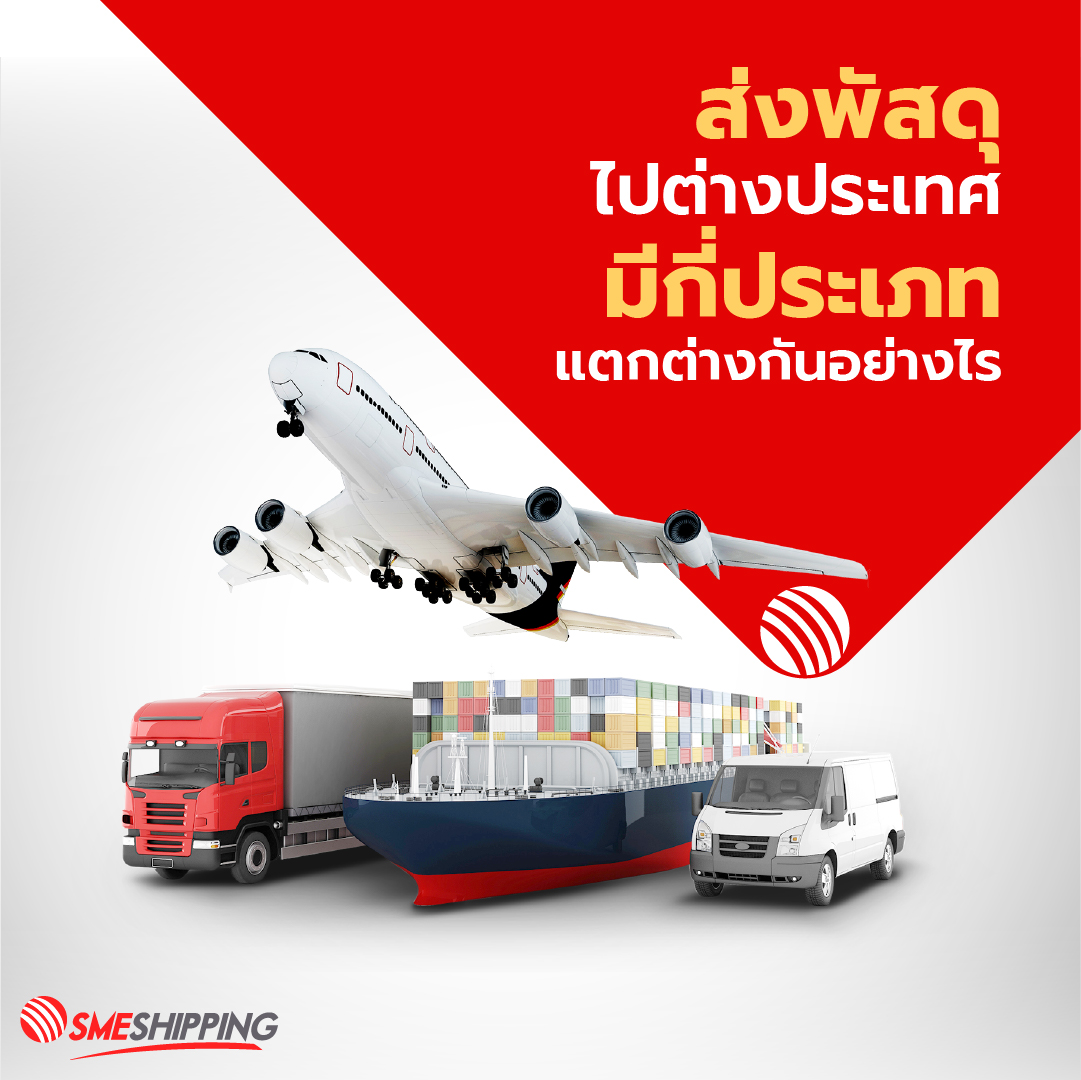
What are the different types of international parcel shipping methods, and what are the differences between them?

In today's world, international shipping is incredibly easy, and with SMEs increasingly focusing on overseas markets, technology and shipping options have developed significantly. But if you're a beginner and want to start shipping your goods internationally, which method is best? Today, we'll introduce you to the different types of international shipping and their differences to help you make an informed decision.

  1. Air freight services

This is the fastest shipping method, but it is also the most expensive. It is suitable for goods that need to be delivered urgently. 

Or, if they are easily damaged, they are commonly shipped in small quantities, such as food, vegetables, fruits, machinery parts, and jewelry.

Advantages of air transport.


  • We can deliver goods to a wide area.
  • The product insurance premium is low because it can be shipped quickly.
  • It is highly secure, under the supervision of airlines and airports.
  • Reduce the costs associated with warehousing and inventory management.
  • It is highly reliable. 
  • Fast and on time. 


  1. Sea freight services

Suitable for transporting large quantities of goods, with low costs. Generally, transportation...

Cargo ships will take longer to deliver than by air because they travel at speeds of 20 miles per hour across the ocean, meaning shipping can take up to a month to reach its destination. Popular items shipped include raw materials, components, and machinery.

Advantages of shipping by sea.

  • Suitable for transporting large quantities of goods, including items that are unlikely to be damaged and are not urgent.
  • You can share container shipping costs with other operators if you don't have a large quantity of goods.


  1. Transported by truck (Cross Border)

For short distances, it's the most suitable option and can be delivered anywhere, frequently.

This method, when combined with other transportation options, is suitable for shipping to neighboring countries such as Laos, Myanmar, Cambodia, and Malaysia, as it allows for fast delivery and direct contact with the user.

Advantages of truck transportation. 

  • Cost-effective and suitable for transportation along short routes. 
  • It can be tracked in real-time using the service provider's GPS system. 
  • The product can be delivered directly to the user.


  1. Train freight

Suitable for shipping large quantities of heavy goods to nearby countries. Popular items for shipment include oil, cement, construction materials, and food products.

Advantages of transport by train.

  • Low service rates 
  • A large quantity of goods can be transported at once.
  • The speed is similar to, or equivalent to, truck transportation.
  • Avoid traffic problems. 
  • Precise delivery times, under reliable schedules, are available, and some providers offer real-time tracking via GPS, similar to truck transportation.


For SMEs and those looking to export their products internationally, developing a suitable shipping strategy is crucial. This helps businesses consider costs and control budgets effectively. However, choosing a reliable shipping service is equally important.  SME SHIPPING We specialize in international shipping of documents and parcels worldwide. Our services are suitable for small and medium-sized businesses and individual customers, utilizing leading shipping companies. Examples include Fedex, Thailand Post, SF Express, and Teleport.

 The key feature of SME SHIPPING is its convenient Door-to-Door Service, where documents and packages are picked up from the sender and delivered safely to the recipient.