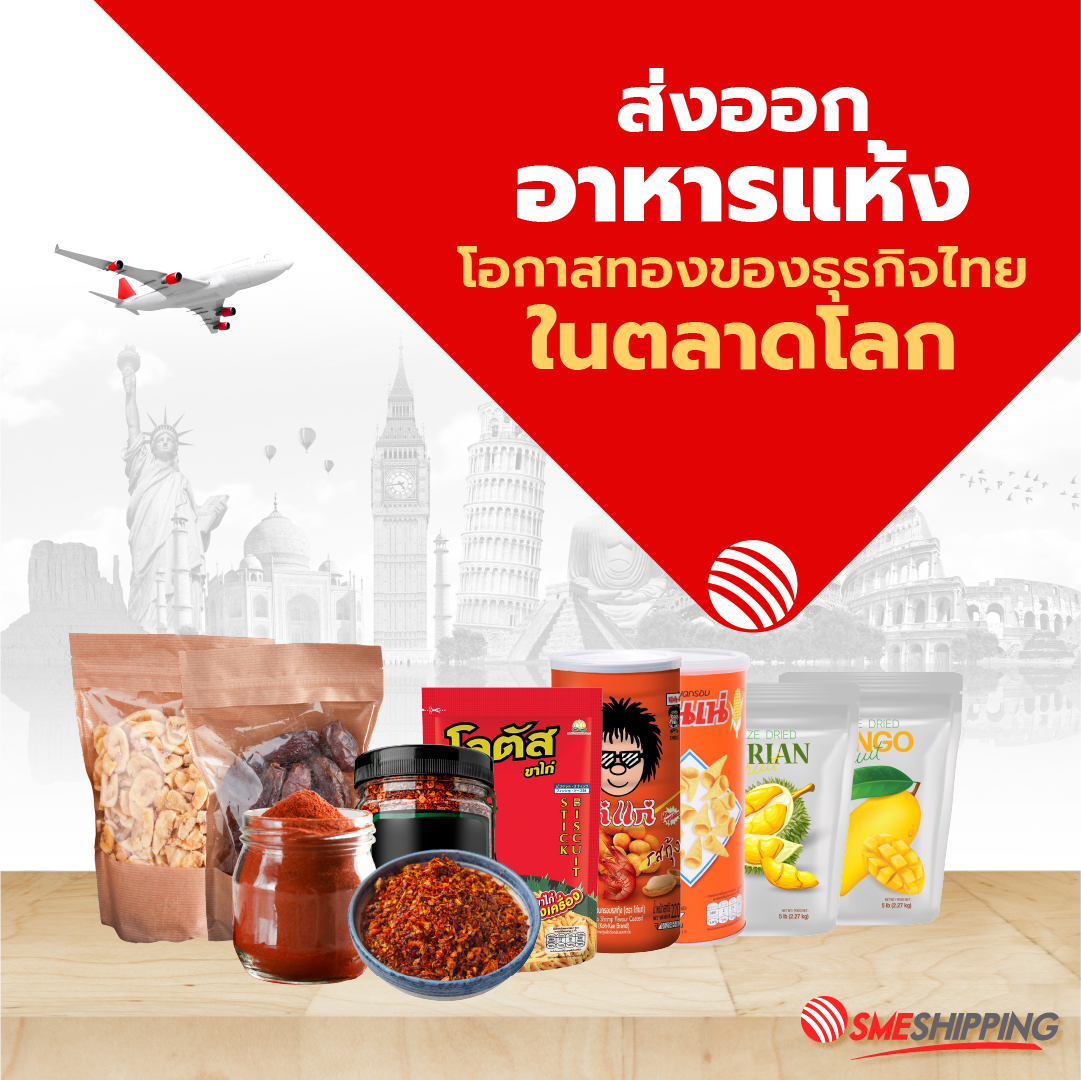
Exporting dried food: A golden opportunity for Thai businesses in the global market.

Dried food is one of the consistently popular export products in the global market. Its variety, delicious taste, and long shelf life make it in demand by consumers worldwide. For Thai businesses, exporting dried food represents a golden opportunity to expand operations and increase revenue. However, before embarking on the export process, it's crucial to understand the relevant steps, procedures, and regulations to ensure a smooth export experience.

Procedures and methods for exporting dried food.

The export of dried food involves the following important steps:

  1. Preparation:
    • Product development: Create high-quality dried food products that are delicious and meet the needs of the target market.
    • Packaging: Choosing the right packaging helps maintain product quality and attract consumer attention.
    • Applying for a license: Inspect and obtain licenses related to food production and export from the relevant government agencies.
  2. Market research:
    • Market analysis: Study the target market, including consumer behavior, competitors, and relevant regulations.
    • Finding customers: Attend trade shows, contact buyers directly, or use a distributor.
  3. Document preparation:
    • Export documents: Prepare the necessary export documents, such as the Export Declaration, Commercial Invoice, and Certificate of Origin.
    • Other documents: Additional documents may be required according to the requirements of the destination country, such as a health certificate or analysis certificate.
  4. Transportation:
    • Choose your shipping method: Choose the transportation method that is most suitable for the goods and the destination country, such as sea, air, or land transport.
    • Purchasing insurance: Purchase cargo insurance to protect against damage or loss during transportation.
  5. Customs clearance procedures:
    • Tax payment: Pay any applicable taxes and fees as required by the destination country.
    • Customs clearance: Waiting for customs clearance of the goods.

Interesting export markets for dried food.

Attractive export markets for dried food products for Thai entrepreneurs include:

  • China: A large market with a demand for a wide variety of dried foods.
  • United States of America: A market with high purchasing power and openness to imported food products.
  • Japan: A market that prioritizes food quality and safety.
  • European Union: The market has strict food regulations, but there are opportunities for high-quality products.
  • ASEAN: A market with rapid economic growth and increasing demand for dried food.

Documents required for exporting dried food.

The essential documents required for exporting dried food include:

  • Export Declaration
  • Commercial Invoice
  • Certificate of Origin
  • Health Certificate
  • Analysis Certificate
  • Other documents as required by the destination country.

Demand for dried food in foreign countries.

The demand for dried food in foreign countries is expected to continue increasing because...

  • Population growth: The increasing global population has led to a higher demand for food.
  • Lifestyle changes: People have less time to cook, making convenient and quick dried foods popular.
  • Interest in health: Consumers are becoming more health-conscious, leading to increased demand for healthy dried foods.

Food regulations in the destination country.

Each country has different food regulations. Exporters should study and strictly adhere to these regulations to avoid problems during export.

Export dried food with confidence with SME Shipping.

SME Shipping is ready to support your business in exporting dried food products worldwide with comprehensive and reliable services.

  • Various delivery options are available: Choose the service that best suits your needs, whether it's express delivery, economy delivery, or shipping large items.
  • Customs clearance expert: We provide consultation and assistance in customs clearance procedures, ensuring your export process is smooth and worry-free.
  • Track your shipment: You can check the shipping status 24/7 for peace of mind.

Ready to export dried food products worldwide? Contact SME Shipping today!

  • LINE: @Shipping
  • Tel: 021057777

Exporting dried food products presents a great opportunity for Thai entrepreneurs to expand their businesses into the global market. With thorough preparation, market research, and compliance with relevant regulations, export success is certainly achievable.


What is dropshipping? Online store owners need to understand this before they start shipping products.

When starting an online business, the transportation of goods between seller and buyer begins as soon as an order is placed. The seller or online store must drop off the packages with a delivery service, either in person or by arranging for pickup. Today, we'll learn about the type of delivery that stores handle themselves, also known as "shipping."“Dropoff”

What is dropoff?

Dropoff This refers to the seller delivering the package to a designated location provided by a shipping service provider, such as Thailand Post., Kerry Express, J&T, Flash Express etc., in order to deliver packages to customers.Dropoff It contributes to making online shipping more convenient and faster, saving senders time by eliminating the need to wait in long queues. This is ideal for online stores that need to ship a large volume of products and don't want to waste time waiting for courier services to pick them up from their home.

What are the advantages of dropshipping for online stores?

 In the transportation of goods, Dropoff There are advantages that help online stores operate more quickly, as follows:

  1.     Save time in shipping goods. Previously, sellers had to wait for courier services to pick up packages from their home or store, but now they can deliver packages to designated points. Dropoff Getting it done immediately will help the product reach the recipient faster.
  2.     point Dropoff There are many providers and prices to choose from, as well as various service points scattered throughout the community, such as convenience stores or transportation centers. This allows sellers to choose the most convenient delivery time.
  3.     Fast delivery, receive a tracking number immediately upon arrival at the destination. Dropoff The seller simply provides the information or scans the barcode from the shipping system, and the staff will issue a tracking number, allowing the seller to immediately confirm the shipment to the customer.
  4.     This service is ideal for businesses that need to ship many items daily, as it handles a large volume of packages and can ship more than 50 items per day.

How to drop off a parcel with a shipping company.

  1.     Print the shipping label.Shipping Label) From the transportation system.
  2.     Attach the shipping label to the package.
  3.     Deliver it to the designated point. Dropoff And receive a confirmation receipt.
  4.     Shipping fees will be calculated in advance in the system (via the shipping company's application or website), at which point... Dropoff Some places may charge additional fees in special cases.


Dropoff Method: Easy shipping, near you.

Just print it. Shipping Label From the SME SHIPPING system, then take the parcel. Dropoff Obtained at All branches of Thailand Post nationwide. The steps are simple:

  1. Create an order through the SME SHIPPING system.
  2. Print the shipping label and attach it to the package.
  3. Take the package to the nearest post office.

Suitable for customers who need to send items urgently or prefer to deliver them themselves.

Pickup Service: Our professional team will pick up your order from your doorstep.

If you don't have time to go to a drop-off point, don't worry! SME SHIPPING offers a service. Request a parcel pickup from your doorstep. We cover every province across Thailand. Simply provide your parcel information and choose a convenient time, and our team will pick it up from your location, making your delivery fast and worry-free.

Why choose SME SHIPPING?

  • convenient: Both drop-off and pick-up services are available.
  • comprehensive: Nationwide service, no matter where you are.
  • Rest assured: Secure shipping with parcel tracking.

Start using SME SHIPPING today!

Choose the shipping method that suits you, whether it's drop-off or pick-up, and get ready for the fastest and easiest parcel delivery experience with SME SHIPPING.

register and Start shipping. Get it immediately at SME SHIPPING or contact our team for more information. We'll take care of you every step of the way!

What you should know about a commercial invoice before exporting goods.

Before engaging in export business or international trade, it's crucial to know how to properly manage all documentation to prevent errors in the shipment of all types of goods. One of these important documents is called... Commercial invoice ((Commercial Invoice) This is a document that companies and individuals who want to do export business must study and accurately check to ensure that the goods reach the recipient safely.

Commercial Invoice What is?

Commercial Invoice A commercial invoice is a document used to confirm the sale and transfer of ownership of goods between an importer and an exporter. This document details the goods, the trade transaction, and assists in customs clearance procedures at both the country of origin and the destination. Understanding the correct preparation and use of a commercial invoice is crucial.

 Commercial Invoice Why is it important??

Commercial invoice ((Commercial Invoice) This is a document from the seller.Exporter) Issued to the buyer (Importer) Confirming sales details is crucial in the export and import process, as it is a key document used in many stages, from international trade to customs clearance, as follows:

  1. It is used as evidence of international sales transactions to specify details about the goods sold and the terms of the transaction, such as price, quantity, delivery terms, payment methods, and helps prevent disputes between buyers and sellers.Importer) And the seller (Exporter)
  2. This document is used by customs authorities in both the country of origin and destination to inspect goods, calculate import and export duties and other fees. If the information in... Commercial Invoice Incomplete or inaccurate information may cause delays in customs clearance.
  3. This information is used to calculate tax values, such as product value and delivery terms.FOB, CIF etc.) and transportation costs are used to calculate the tax rate that must be paid.
  4. Used to confirm international payments made through banks (e.g., Letter of Credit or L/C) The bank then requires an invoice to confirm the transaction. The buyer can then use this invoice or document to request payment from the bank or forward it to the relevant party.
  5. Used in freight management, invoices contain information related to transportation, such as product details, quantity, and delivery terms, enabling transportation service providers to operate accurately.
  6. Invoices are used as legal documents to confirm agreements between buyers and sellers. In case of problems, such as goods not meeting specifications or price disputes, invoices can be used as evidence in negotiations or legal proceedings.
  7. Enhances business credibility, strengthens the professional and trustworthy image of sellers, and helps build confidence with business partners and fosters business relationships.

Commercial Invoice What information is required??

Preparation Commercial Invoice Accurate and complete information is crucial to prevent problems in international trade and customs clearance. The following is information that should be included in the document.

  1.     Name and address of the seller (exporter) and the buyer (importer).
  2.     Product details: Product name, quantity, unit price, and total price.
  3.     The invoice date, document number, and reference to the order number or contract number that was specified and agreed upon in advance.
  4.     Delivery Agreement (Incoterms
  5.     Payment agreement (Payment Terms)
  6.     Origin and destination locations for shipping goods.
  7.     Product weight, number of packages, shipping marks (Shipping Mark)
  8.     Signature and seal certified by the seller (exporter).


Commercial Invoice It's more than just an ordinary document. Because it is a commercial invoice that plays a crucial role in legal aspects, transactions, transportation, and tax management, preparation... Commercial Invoice Complete and accurate information helps ensure a smooth and efficient export process. Choosing a transportation service that has knowledge and experience in shipping goods for export to foreign countries is essential. SME SHIPPING This is another option that can help ensure goods are transported quickly and arrive safely to the recipient without worry. 

Information you should know about FOB.

Section 1: Getting to Know FOB (Free on Board)

Importing and exporting goods are crucial activities that connect economies worldwide. In this process, one of the most important terms in goods transportation is FOB, or Free on Board, a term used to define the terms of shipment in international markets. This article will consider the basic meaning and significance of FOB in international trade.

The basic definition of FOB.

FOB (Free on Board) is a shipping document term that states the seller is responsible for delivering the goods to the destination, and once the goods are loaded onto the ship, all risk and costs are transferred to the buyer. Conversely, it means that once the goods are loaded onto the ship at the exporter's country's port, the buyer becomes responsible for the goods from that point onward.

The importance of FOB in international trade.

Understanding FOB terms is crucial in international trade because it helps define the responsibilities for costs and risks in the process of transporting goods from seller to buyer. This includes freight costs, insurance, and port charges. Clearly defining these from the outset helps minimize misunderstandings and potential disputes later on.
FOB terms also allow buyers to control transportation costs, especially in situations where they have agreements with shipping companies they trust more. Furthermore, using FOB terms ensures transparency in the shipping process, particularly in terms of insurance and logistics management.
In summary, FOB (Free on Board) is a crucial element in international trade that all parties should understand and implement for effective risk and cost management. By leveraging this foundation, businesses can gain a competitive advantage and effectively expand their access to global markets.

Section 2: The Difference Between Shipping Point and Destination

FOB, or Free On Board, is a shipping agreement that specifies at what point in the transportation process the responsibility for costs and risks associated with the goods is transferred from the seller to the buyer. This term is commonly used in international transactions to clarify the terms of transport and transfer of ownership of the goods.

FOB Shipping Point vs. FOB Destination

FOB Shipping Point means that responsibility and costs for shipping the goods are transferred from the seller to the buyer from the moment the goods are shipped from the warehouse or point of origin. This means the buyer bears all risk and costs from the moment the goods leave the seller.
FOB Destination, as opposed to FOB Shipping Point, means that the seller is responsible for the goods until they reach the buyer at the destination. Under this condition, the seller bears all costs and risks of transportation until the goods are delivered to the buyer.

Legal consequences and responsibilities.

Both FOB Shipping Point and FOB Destination have legal implications and liability in the event of damage or loss during transit.[6] Under FOB Shipping Point terms, if the goods are damaged or lost in transit, the buyer assumes the risk. Under FOB Destination, the seller assumes the risk until the goods are safely delivered to the buyer.
Choosing between an FOB shipping point or an FOB destination is crucial in defining each party's legal responsibilities, and this should be clearly stated in the trade contract to prevent misunderstandings and problems later on.

Section 3: The Importance of FOB (Free on Board)

For smooth export and import transactions in Thailand, using and understanding the term FOB (Free On Board) is essential. This term helps identify where the burden of costs and risks in transporting goods is transferred from the seller to the buyer along the shipping route.

FOB (Free On Board) for importing and exporting goods in Thailand.

Exporting: For businesses wishing to export goods from Thailand, FOB terms can be used. This means the seller transfers responsibility for the costs and risks of shipping the goods to the buyer. Under an FOB agreement, the exporting seller is responsible for all costs and risks until the goods arrive at their final destination.
Import: Once the company's export vessel's container arrives at a port in Thailand, the goods are deemed transferred from the seller to the buyer, and the buyer becomes responsible for further handling and payment of costs.

Precautions and recommendations.

Understanding Liability: Businesses should understand that they are responsible for their own risks and costs in FOB agreements, whether from the sender's or receiver's perspective.
Clear communication is essential: A thorough understanding of what FOB Shipping Point and FOB Destination mean, and clear communication with trading partners are necessary to prevent misunderstandings.
Clearly state on the delivery note: In many high-level cases, the delivery note should clearly indicate whether the goods are being transported FOB (Fair-to-Ob shipping point) or FOB (Fair-to-Ob destination).
Having the right insurance policy is crucial: Cargo insurance can help protect against the risks posed by shippers or recipients of goods. Businesses should consider what type of insurance they need for their cargo.
Overall, for successful export and import business operations, knowledge and understanding of trade and shipping conditions, key planning and operational aspects, and knowledge of international trade are essential.

Section 4: FOB and Shipping Standards

International trade utilizes standard shipping terms to clarify the duties and responsibilities of both sellers and buyers. Incoterms (International Commercial Terms) are the standard laws used to define these terms. This article will focus on comparing FOB (Free On Board) with other Incoterms shipping terms such as CIF (Cost, Insurance and Freight), EXW (Ex Works), and others.

FOB (Free On Board)

FOB is commonly used for sea shipping. The seller is responsible for loading the goods onto the ship and handling all related expenses until the goods are loaded. After that, responsibility is transferred to the buyer, who must bear all costs and risks incurred thereafter.

CIF (Cost, Insurance and Freight)

CIF is also suitable for sea transport, but the seller is responsible for paying the freight and insurance costs until reaching the destination port. The risk of the goods is transferred to the buyer once the goods cross the ship's shore.

EXW (Ex Works)

EXW places the least responsibility on the seller, with the buyer handling everything from receiving the goods from the seller's factory, including transportation, insurance, and other related matters. This is the condition that places the most burden on the buyer.

Comparison summary

FOB: The seller is responsible until the goods are on board the ship; after that, the buyer assumes the risk and costs.
CIF: The seller is responsible for freight and insurance costs until the goods reach the destination port. The risk transfers to the buyer once the goods cross the ship's shore.
EXW: The buyer assumes all responsibility from the moment they receive the goods from the seller's factory.
The choice of terms depends on considerations of risk, cost, and ease of management. Advance negotiation and planning between the buyer and seller are crucial to finding the best possible agreement for both parties in each trade transaction.

Section 5: FOB Terms and Conditions Regarding Cost and Risk Management.

Managing the costs and risks of shipping goods under FOB (Free On Board) terms requires careful planning and decision-making regarding insurance and transportation. Because FOB terms stipulate that the seller is responsible for delivering the goods at the shipping shore, after which all responsibilities and risks are transferred to the buyer, advance planning and appropriate insurance are crucial.

Insurance decisions

Shipping insurance is important as it helps reduce the risks that both buyers and sellers may face, including damage or loss of goods. When deciding on insurance, the following should be considered:
Risk assessment: Consider factors that may affect the goods during transportation, such as the transportation route, type of goods, and the value of the goods.
Choose the right insurance: There are many types of insurance plans that offer different levels of coverage. For example, All Risks insurance covers most risks, and Named Perils insurance covers only specific risks.
Cost-value analysis of insurance: It is necessary to compare the cost of purchasing insurance with the value of the product and the potential risks involved.
Decisions regarding transportation.
Choosing the shipping method and company is another important decision to make under FOB terms.
Choose a reliable shipping company: Opt for a company with experience and a good reputation in the industry. Check reviews and request references.
Negotiate shipping terms: This includes pricing, delivery times, and agreements on handling emergencies or delays.
Verify transportation coverage: Ensure the transportation service covers the entire process from origin to destination and manages potential risks along the way.
Managing transportation costs and risks under FOB terms requires comprehensive planning and sound decision-making, encompassing both insurance and the selection of transportation companies, to ensure a smooth transportation process and minimize potential risks.

Beginners should know! How to get started with your first export shipment?

 Starting an export business is a step for businesses looking to expand their markets and increase revenue. With good planning, market analysis, targeted strategies, and the selection of reliable transportation services, your business can grow and access a wider global market. However, success requires careful planning and preparation, which for beginners may seem complex and daunting. Today... SME SHIPPING We will answer your questions and provide basic advice so that novice entrepreneurs can confidently start their export business.


What is an export business??

Export business Exporting is a business activity involving the sale of goods from one country to another in order to generate income for the entrepreneur and expand markets and customer bases worldwide. Generally, popular export products are domestically produced goods of high quality, in demand by international buyers, and competitively priced to generate profits for the entrepreneur.


 Key steps in starting an export business.

Exporting is a crucial step for businesses seeking to expand their markets, generate revenue, build a larger customer base, and increase profits. The following steps provide a basic guideline to help novice exporters navigate the process smoothly:

  1. Analyze customer segments and products that are currently in demand in the market.

Before starting an export business, it's crucial to conduct market research to ensure the products you wish to export align with the needs of the target market. Thoroughly studying the target market, including consumer behavior, regulations, trade rules, and competitors, will help newcomers planning to export goods develop effective marketing strategies.

  1. Prepare all necessary production documentation.

When exporting any type of product, you must check what licenses are required. For example, you may need a license to export controlled goods, a procedural document detailing product specifications, price, quantity, and other relevant information, and a bill of lading, which is crucial proof of ownership. For some products, a certificate of origin (where the product was manufactured) and a phytosanitary certificate (Food and Drug Administration/Thailand Industrial Standards) may also be required. And other quality certificates as required by the regulations of the destination country.


  1. Study and understand taxes and duties.

In any business endeavor, entrepreneurs must thoroughly study tax regulations, including export taxes payable upon departure from the country, import taxes levied by the destination country on imported goods, and import duties imposed on certain types of goods, in order to properly utilize value-added tax (VAT) credits.

  1. Choose a reliable shipping company.

Choosing a reliable shipping company with good customer reviews can help ensure a smooth export business. Factors to consider and select include:

  • Compare prices and choose a company with shipping costs that fit your budget.
  • We offer parcel delivery services to various countries, such as freight forwarding services. SME SHIPPING We provide shipping services from Thailand to the USA, China, Singapore, Australia, Japan, the UK, South Korea, Hong Kong, and Taiwan.
  • Other services include insurance and tracking, allowing senders to monitor their shipments at all times.


How many shipping options are there for export businesses??

Choosing the right shipping method is crucial for export businesses as it affects costs, transportation time, and product safety. The main shipping channels are...SME SHIPPING The following are some examples:

  1. Land transportation Suitable for goods shipped between neighboring countries, it offers flexibility in transportation and is a transportation channel that can handle a wide variety of products.
  2. Deliveries by sea Suitable for goods that are in large quantities, heavy, or require shipment in large amounts at a time, such as agricultural products, raw materials, household goods, or general merchandise.
  3.  Air transport Suitable for high-value, lightweight goods that require fast delivery, such as electronic equipment, spare parts, and other valuable items.

Things to consider when shipping goods with expiration dates internationally.

Shipping products with expiration dates internationally requires special care, as several factors must be considered to ensure the goods arrive in usable condition and legally in the destination country. Our recommended shipping method for expired goods, for the fastest delivery, is air freight. This is the fastest method and eliminates concerns about expiration dates. However, for those who cannot afford air freight, what can be done to prevent damage or expiration during transit? Let's check the following list.

1. Regulations of the destination country.

Before shipping goods internationally, be sure to check if that country has any regulations or prohibited items that are not allowed to be imported. Sending unauthorized goods may result in wasted shipping costs. The prohibited items vary from country to country, for example:

  • Food and Beverages: Each country has different regulations regarding the import of food and beverages. There may be restrictions on the type of goods, quantity, and required documents.
  • Pharmaceuticals and health products: These types of products often have strict import regulations and require permits from the relevant authorities.
  • Agricultural products: Agricultural crops may have import restrictions to prevent the spread of plant diseases and pests.
  • Required documents: Ensure you have all necessary documents, such as certificates of origin, import licenses, and invoices.

2. Shipping time.

The shipping time for products with expiration dates internationally is a crucial factor affecting product freshness and recipient satisfaction. The distance between the origin and destination countries directly impacts transit time; the further the distance, the longer the shipping time. Therefore, choosing the right shipping method ensures quick delivery while maintaining product quality.

3. Packaging

Choosing strong and durable packaging materials will help prevent movement inside the box and damage. Furthermore, selecting thick, sturdy, and standard-compliant shipping boxes will ensure that materials shipped internationally arrive in the best possible condition to the recipient.

4. Product labels

Clearly labeling products to indicate the product name, expiration date, and other relevant information helps delivery personnel categorize items for faster delivery. Therefore, before handing over any package or product, senders must always check the expiration date before arranging delivery.

5. Transportation temperature.

For certain types of goods, such as frozen or temperature-sensitive products, temperature control is required throughout transportation. Therefore, maintaining the correct temperature during transport is crucial, especially for temperature-sensitive items like frozen food, which must be properly insulated from the moment they are packed. The vehicle or cargo compartment itself must also maintain the appropriate temperature for the goods, ensuring they arrive in the same condition as they did at their origin.

6. Plan your shipments in advance.

 If the products to be shipped have expiration dates, it is necessary to plan the route and transportation procedures in advance to minimize the risk of delays and products expiring before reaching the recipient. Unexpected accidents can sometimes occur during transportation, so planning ahead is a good way to handle shipping expired goods internationally.


Choosing an experienced shipping company means selecting a trustworthy company with expertise in international shipping. SME SHIPPING specializes in shipping documents and parcels worldwide. Our services are suitable for small and medium-sized businesses and individual customers, utilizing leading shipping companies such as FedEx, Thailand Post, SF Express, and Teleport, among others.

 The key feature of SME SHIPPING is its convenient Door-to-Door Service, where documents and packages are picked up from the sender and delivered safely to the recipient.

Before you ship, you need to know! How to correctly calculate the weight and shipping costs of your parcel before sending it internationally.

Shipping costs, whether domestic or international, vary depending on the weight and type of goods. Therefore, calculating the weight and shipping costs before sending goods internationally is a crucial step that shouldn't be overlooked. This ensures a smooth and cost-effective delivery to the recipient.


Why do we need to calculate weight and shipping costs before shipping goods??

Calculating weight and shipping costs helps senders estimate expenses and plan their shipping budget accurately. Accurate parcel cost calculations also help prevent potential problems such as inflated costs or delayed deliveries. Furthermore, some items require insurance during transit. Therefore, knowing how to accurately calculate shipping costs allows for international shipping within the planned budget.


Factors affecting transportation costs.

When transporting goods, whether domestically or internationally, shipping service providers will charge actual shipping fees based on the following main factors:

  1. Package weight: Package weight is a major factor affecting shipping costs. Generally, charges are based on the actual weight of the package, including the weight of the box after it has been packed.
  2. For large but lightweight packages, some shipping companies may charge based on the package's volume instead (length x width x height).
  3. Distance: The distance for shipping goods, calculated from the country of origin to the country of destination, affects shipping costs. The further the distance, the longer the shipping time.
  4. Types of goods: Some types of goods may have higher shipping costs, such as hazardous materials or high-value goods that require extra care and insurance to prevent loss during transit.
  5. Additional services: In addition to delivery time and weight, international shipping costs may include additional services such as insurance, tracking, or express shipping, which may incur extra charges.


How to calculate shipping costs based on the weight of the item.

Shipping costs may vary from place to place, but they are usually calculated as follows:

  • Calculated based on the actual weight of the product + shipping cost: Actual weight of product X Shipping rate per kilogram = Shipping cost.
  • Use the online shipping cost calculator or program on the website of the company you choose to use.
  • Contact the shipping company to inquire about shipping costs directly. Their staff will help you calculate the costs and provide further advice.

However, if you choose to use the services of... SME SHIPPING For those who provide international air freight services with a comprehensive worldwide shipping service through leading transportation companies, you no longer need to worry about sending goods abroad because the website has a page... check-price You can check the actual price of your goods before delivery, without worrying about exceeding your budget. Plus, we guarantee direct delivery to your doorstep. 

5 Ways to Protect Goods from Moisture and Damage During International Shipping.

International shipping presents another challenge for both senders and recipients: the condition of the goods upon arrival. Several factors influence transit, one of which is moisture, which can affect the quality and integrity of the goods, especially if unsuitable packaging is chosen. To prevent this, we offer... 5 Here's how to protect your goods from moisture and damage during international shipping, for those planning to ship goods internationally:

1. Choose the appropriate packaging.

Choosing the right packaging for your product is the first line of defense in ensuring its safety during transportation. Selecting the correct size packaging will minimize internal movement and prevent damage from impacts. Furthermore, using bubble wrap helps protect the product., Wrapping film, Placing coated cardboard boxes or vacuum-sealed bags inside the shipping box will help prevent moisture damage to the goods and reduce impact more effectively.

2. Clearly label products during shipping.

Clearly labeling products on the front of the box helps ensure quick and accurate delivery. Unclear or incomplete labels can lead to problems such as lost, damaged, or delayed goods, affecting both the sender and receiver. Furthermore, product identification allows for tracking throughout the transportation process and helps reduce errors in product arrangement and delivery.

3. Use silica gel desiccant.Silica gel)

If the product is highly humid or requires special care during shipping, waterproof materials and desiccants such as silica gel should be used.Silica gel) Place the desiccant bags inside the packaging to absorb excess moisture. Using desiccant bags of the appropriate size and quantity for the packaging will ensure optimal effectiveness.

4. Choose the most suitable transportation service.

Choosing a shipping provider with short delivery times and the ability to track packages throughout the shipping process is one way to better reduce damage during transit. For example, the parcel delivery service of... SME SHIPPING Fast and efficient worldwide parcel delivery service, delivered directly to your door.

5. Insure your goods.

Cargo insurance is another way to provide added protection against damage from moisture or other causes during transportation. This protection can stem from various factors such as shipping accidents, theft, natural disasters, or damage from improper packaging. Furthermore, insurance offers senders peace of mind and confidence that the shipping company will compensate for any damage to their goods in the event of unforeseen circumstances. International cargo insurance comes in several types, each offering different levels of coverage.

  •         Type of coverage All Risks This coverage includes all types of damages except those caused by reasons specified in the policy.
  •         Type of coverage Named Perils This coverage specifies particular damages that require protection, such as loss, theft, fire damage, etc.


Choosing an experienced shipping company means selecting a trustworthy company with expertise in international shipping. SME SHIPPING specializes in shipping documents and parcels worldwide. Our services are suitable for small and medium-sized businesses and individual customers, utilizing leading shipping companies such as FedEx, Thailand Post, SF Express, and Teleport, among others.

 The key feature of SME SHIPPING is its convenient Door-to-Door Service, where documents and packages are picked up from the sender and delivered safely to the recipient.


What preparations should be made if you want to import a large quantity of goods from abroad?

For entrepreneurs who want to import goods from abroad, whether for resale or to source raw materials to develop their own products, they often need to import large quantities. For novice entrepreneurs, this can be worrying because importing large quantities of goods from overseas may seem complicated. However, being prepared can help minimize potential problems. Today, let's look at how to prepare for a safe, reliable, and worry-free import process!


Study the requirements and regulations of the destination country from which the goods are imported.

Each destination country has different regulations and requirements for importing goods. For example, some items may require special licenses or customs inspections. Therefore, it's advisable to be prepared by studying these regulations and considering whether the goods you intend to import are on any prohibited lists.


Check the tax requirements and any necessary expenses.

When importing large quantities of goods, importers need to study details such as import duties, shipping costs, insurance, and customs clearance fees. These are factors that businesses need to consider in order to prepare for expenses and understand the total import cost.


Please prepare all necessary documents.

When importing goods, businesses should be aware of essential import documents such as invoices, packing lists, and certificates of origin. Additionally, they should check whether any other documents are required by the customs authorities of the destination country. 


Insure your goods.

Importing large quantities of goods is a high-value and costly undertaking. Therefore, to ensure the safety of the goods and prevent potential damage, cargo insurance during transit is recommended. If goods are dropped or damaged during transit, insurance will help cover losses and related expenses.


Choose an experienced shipping company. 

Choosing an experienced and specialized shipping company will give you peace of mind knowing your imported goods are safe and secure, as they are in the hands of a trustworthy company. Furthermore, experienced shipping companies can provide valuable advice and guidance to businesses. 


Importing large quantities of goods requires careful planning and preparation. Businesses must study and understand regulations to ensure all necessary documentation is complete. Thorough preparation also allows for an assessment of costs and expenses. Equally important is choosing an experienced and trustworthy shipping company specializing in international freight. SME SHIPPING specializes in shipping documents and parcels worldwide. Our services are suitable for small and medium-sized businesses and individual customers, utilizing leading shipping companies such as FedEx, Thailand Post, SF Express, and Teleport.

 The key feature of SME SHIPPING is its convenient Door-to-Door Service, where documents and packages are picked up from the sender and delivered safely to the recipient.

If a shipment is returned to sender from overseas, how should we handle it?

For small business owners and entrepreneurs who need to ship goods internationally, everyone hopes for the fastest and safest delivery. However, it's always a headache when a shipment is returned, as it may mean that the carefully selected goods haven't reached the recipient as expected. This can lead to customer dissatisfaction and damage the reputation of the product and service. But why do shipments get returned, and how can we handle this frustrating situation? 


Why was my package returned after I sent it?


The destination address is incorrect: It may seem like a simple reason, but believe it or not, this happens more often than you think and is a popular reason for packages being returned. Incorrect or unclear address information can prevent delivery personnel from delivering the package. To prevent this, you should always double-check your address details to ensure they are correct and complete before sending any goods.


No recipient at the destination: Sometimes, packages are returned because the delivery person is unable to deliver them to the recipient. Alternatively, problems may arise if the recipient lives in a condominium or building without a management office to receive the package. It's best to discuss the delivery and pickup details with the customer beforehand to ensure the package will be delivered safely. 


This is a prohibited item. Some items are prohibited goods. Shippers need to carefully study international shipping laws before sending goods and consider whether their items fall under the prohibited category. If the goods are prohibited, they may be returned or, in some cases, seized.


Missing necessary documents: Certain goods, such as medicines or chemicals, require accompanying documentation for shipment. Failure to provide this documentation may result in the shipment being returned. Therefore, shippers must carefully study the regulations and permit application procedures before shipping goods.


How do I handle it if a shipment is returned?


Contact the shipping company: Inquire with the shipping company about what happened and why the goods were returned, in order to understand the problem in detail. For example, issues such as incorrect or unclear addresses, missing permits, or the goods not being authorized for export.


Verify documents and address: Ensure the destination address is correct and complete, and correct any errors. Also, check if all necessary documentation for product permits and regulations of the destination country is required.


Check the laws and regulations of the destination country: Study the laws and regulations regarding shipping goods to the destination country to understand any prohibitions or procedures. Make necessary corrections and complete all necessary documents before attempting to ship the item again.


Consider changing service providers: Some shipping providers may lack experience in international shipping, making them unable to advise or successfully handle the delivery of goods to their destination. If this occurs, consider changing service providers. 


For those seeking an experienced, safe, and reliable service provider, SME SHIPPING specializes in international shipping of documents and parcels worldwide. Our services are ideal for small and medium-sized businesses and individual customers, utilizing leading shipping companies such as FedEx, Thailand Post, SF Express, and Teleport.


 The key feature of SME SHIPPING is its convenient Door-to-Door Service, where documents and packages are picked up from the sender and delivered safely to the recipient.