


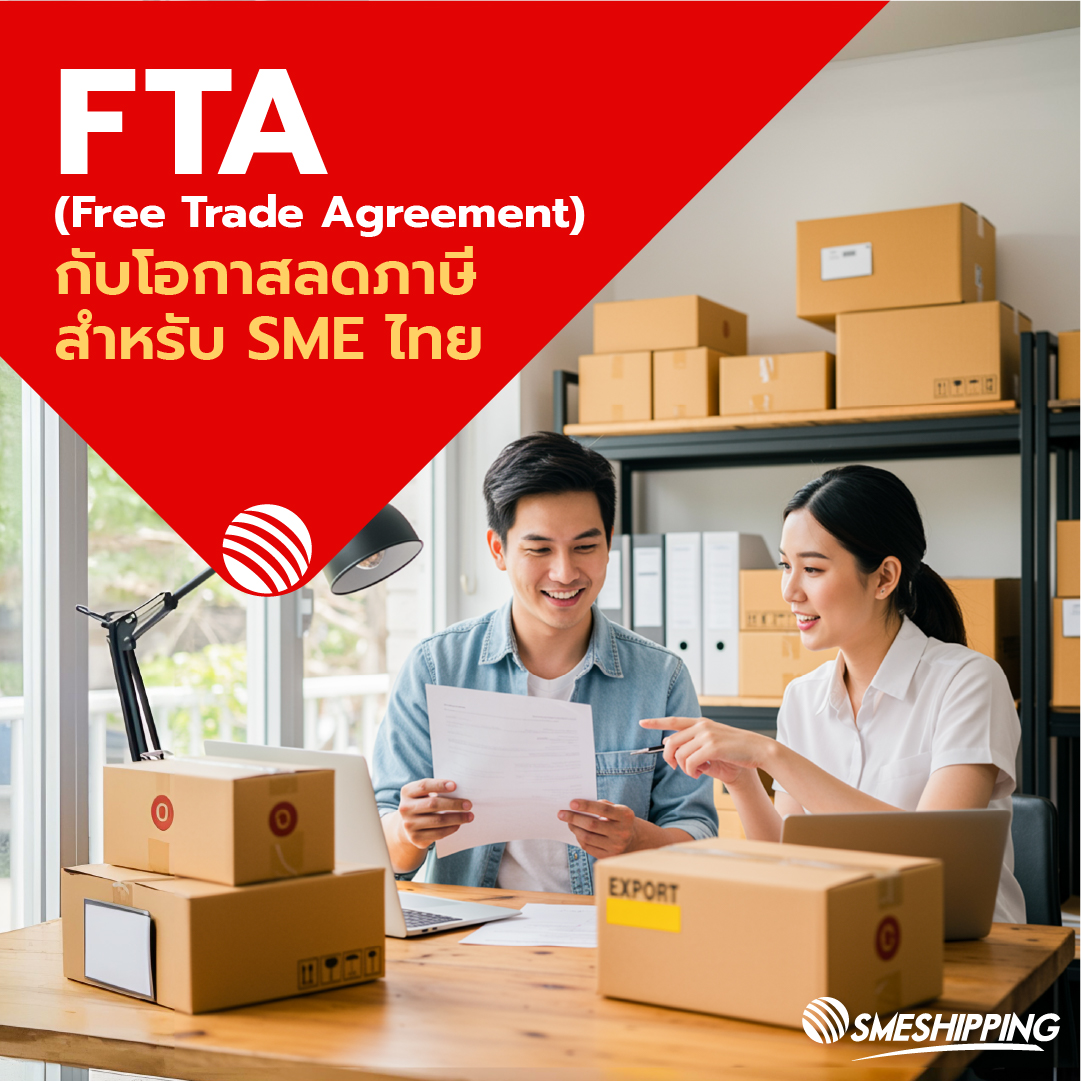
Free Trade Agreements (FTAs) and opportunities for tax reduction for Thai SMEs.
The concept of a Free Trade Agreement (FTA) is a key strategy that opens "doors of opportunity" for Thai SMEs to access foreign markets at reduced costs, especially in terms of import tariffs, which can be reduced to as low as 0% in many cases if the benefits of an FTA are used correctly. It's like a "business pass" that helps Thai products access new markets more easily without bearing the burden of tariffs that hinder competitiveness. This article from SME Shipping will explore what Thai SME entrepreneurs should know about FTAs.
What is an FTA?
A Free Trade Agreement (FTA) is an agreement between two or more countries to promote trade by "reducing or eliminating trade barriers," such as import/export tariffs, tariff measures, or quantitative restrictions, in order to facilitate smoother trade between them. The goal is to enable goods and services from each country to move across borders "freely and fairly."“
With whom does Thailand have FTAs?
Currently, Thailand has both bilateral and multilateral FTAs with many countries, such as:
- ASEAN
- China
- Japan
- South Korea
- Australia – New Zealand
- India
- Chile – Peru – Hong Kong
- RCEP (Regional Comprehensive Economic Partnership)
In total, it covers more than 18 countries, representing more than 60% of Thailand's international trade.
Why do Thai SMEs need to know about FTAs?
In today's global trading world, where cross-border competition is commonplace, Thai SMEs need to seek new opportunities abroad. This is because it's a shortcut to reducing costs and increasing profits for exports. For Thai entrepreneurs, understanding and utilizing the benefits of FTAs will help...
- Export goods without paying import duties in the destination country (for some items, the duty code is 0%).
- Competing in the global market becomes easier because product prices have decreased.
- Expand your market to countries that have FTAs with Thailand with confidence.
- There is an opportunity to access new customers who may previously have been an obstacle due to taxes.
How can SMEs take advantage of FTAs?
- Check if your products are eligible for FTA benefits by visiting the Department of International Trade website or the FTA e-Tariff system to verify whether your products qualify for import tariff reductions.
- Apply for a Certificate of Origin (CO) to demonstrate that your goods were manufactured in Thailand, in accordance with FTA requirements. Applications can be submitted to the Department of International Trade or via electronic systems such as e-Form D or e-CO.
- It is important to understand the "Rules of Origin" (ROO), as each FTA has specific rules regarding "what types of goods" are considered to be manufactured in Thailand. For example, goods may be manufactured or assembled in Thailand, or use domestic raw materials exceeding a specified percentage.
- Prepare all necessary documents, including tax invoices, ingredient lists, production documents, shipping bills, and other documents required for applying for a Certificate of Origin (CO).
- Stay informed about new FTAs, as Thailand is still negotiating market access with new countries such as the EU, EFTA, etc.
Examples of SMEs that have benefited from FTAs.
- A dried fruit manufacturer exporting to China is utilizing the Thailand-China FTA to reduce import tariffs to 0%.
- A wooden furniture factory exporting to Australia uses the Thailand-Australia FTA to reduce tariffs by several times.
- Garment factories use the rule of origin stating "Made in Thailand" to obtain tax breaks in Japan.
FTAs aren't just for big corporations; Thai SMEs of all sizes can use them as a tool to reduce costs, export more easily, and effectively penetrate new markets, if they prepare and utilize them wisely starting today.


 English
  Thai
Thai