


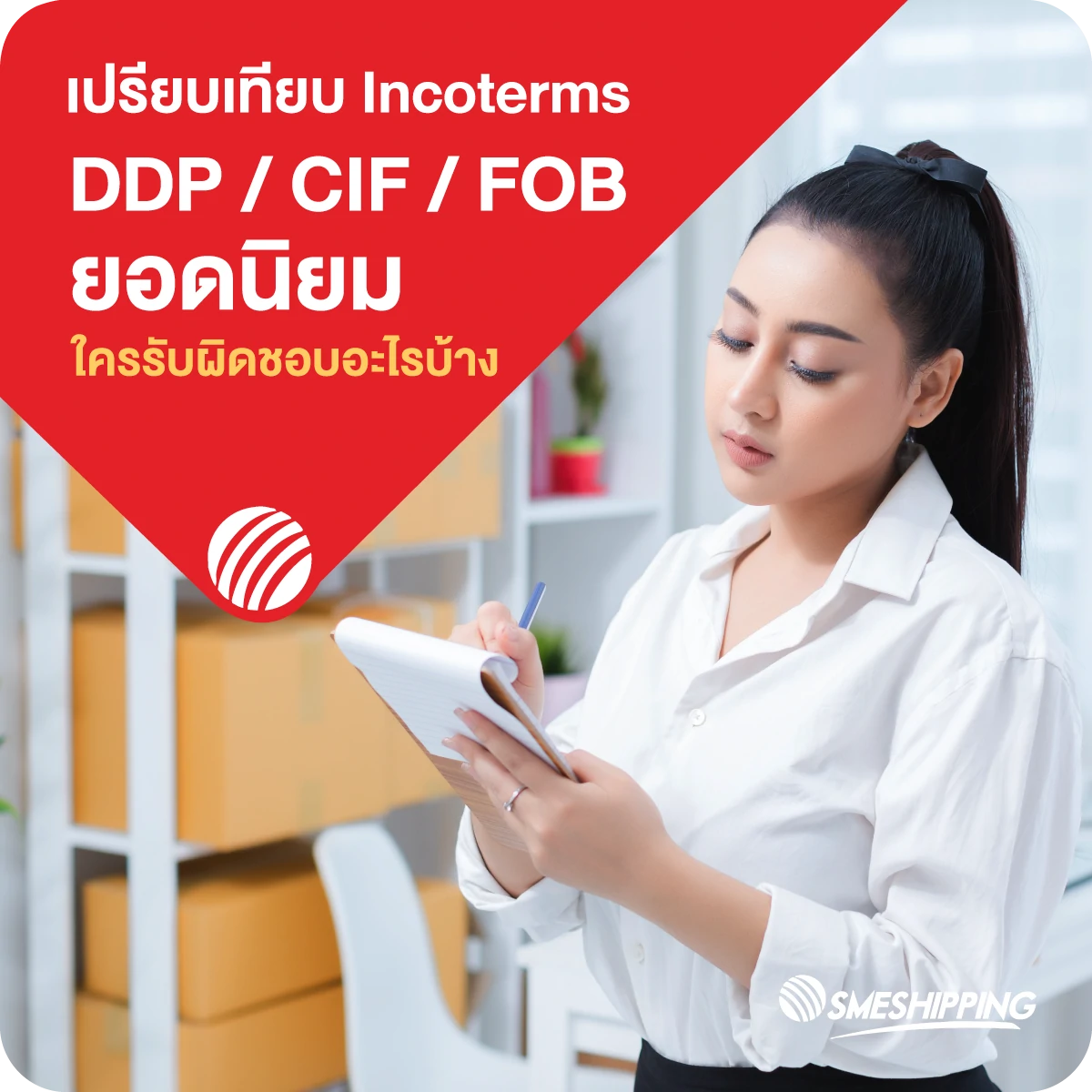
Before setting prices for international sales, it is crucial for businesses to clearly understand that each Incoterm defines the responsibilities, costs, and risks of both the seller and the buyer differently. Commonly used Incoterms in SMEs include DDP, CIF, and FOB, which differ significantly, particularly regarding costs and risks that must be included in the sales price. Incoterms are not just terms of delivery; they define who is responsible for the costs, risks, and various processes from the factory to the final destination.
This article from SME Shipping will provide a simple comparison of popular Incoterms: DDP, CIF, and FOB, to help SMEs choose the terms that best suit their products, market, and business model before deciding on their actual selling prices.
Who is responsible for what in DDP/CIF/FOB arrangements?
- DDP (Delivered Duty Paid) The seller is responsible for everything from the point of origin to the buyer's doorstep, including all taxes and duties. The buyer hardly has to handle anything.
- CIF (Cost, Insurance & Freight) The seller is responsible for the cost of the goods, shipping, and insurance until delivery to the destination port. After that, the buyer is responsible for the import procedures and taxes.
- FOB (Free on Board) The seller is responsible only until the goods are loaded onto the ship at the port of origin. After that, all costs and risks fall on the buyer.
A simple comparison table of Incoterms: DDP / CIF / FOB.
| Procedures / Responsibilities | FOB | CIF | DDP |
| Transportation from seller to port of origin. | Seller | Seller | Seller |
| Export customs procedures | Seller | Seller | Seller |
| The risk of goods being loaded onto the ship. | Seller | Seller | Seller |
| Shipping costs / International freight charges | Buyer | Seller | Seller |
| Cargo insurance costs | Buyer | Seller | Seller |
| Risks after cargo is loaded onto the ship. | Buyer | Buyer | Seller |
| Import customs procedures | Buyer | Buyer | Seller |
| Import taxes and fees | Buyer | Buyer | Seller |
| Shipping to the buyer's address. | Buyer | Buyer | Seller |
| End of seller's obligation. | Onboard (origin) | Onboard (origin) | Buyer's location |
How do different Incoterms affect pricing?
- FOB → The price of the product seems low, but the buyer has a cost burden.
- CIF → Equivalent price, suitable for starting out in the market.
- DDP → Higher price, but it's the "final price," making it easier to close the sale.
Therefore, choosing Incoterms is not just about logistics, but also a pricing and profit management strategy for businesses.
Which Incoterms should SMEs choose?
- To control risk, choose FOB/CIF.
- For convenience and a better customer experience, choose DDP.
- If you're still unsure, try offering the customer more than one Incoterm option to choose from.
Pricing for international markets isn't just about how much to sell for, but about balancing costs, risk, and customer expectations.
- DDP is suitable for sellers who want a service advantage and complete control over the customer experience, but careful cost calculation is necessary.
- CIF is a balance point that allows sellers to control key transportation costs while reducing end-user risk.
- FOB is suitable for sellers who want to focus primarily on product costs and already have customers who are experienced in logistics.
For SMEs, a deep understanding of Incoterms will help them set accurate pricing, avoid losses due to shipping costs, and negotiate professionally with international partners.



 English
  Thai
Thai