


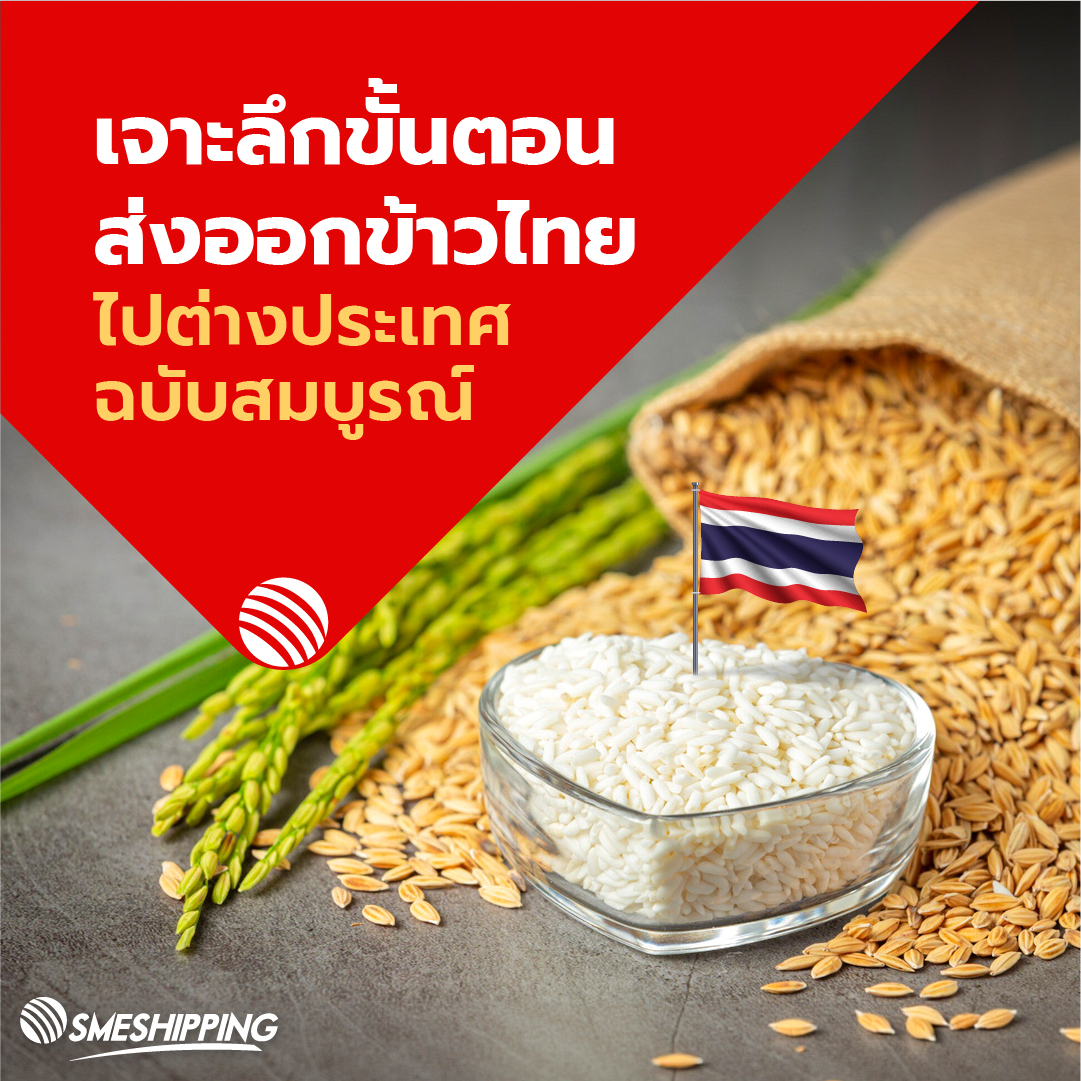
An in-depth look at the complete process of exporting Thai rice to foreign countries.
This article aims to provide in-depth knowledge to entrepreneurs, rice exporters, students, farmers, and the general public by explaining the process. Exporting rice From the beginning to the payment process, including: Rice Export Law and Rice export requirements Related information, along with helpful tips.
1. Introduction: The Importance of Thai Rice Exports
Thailand is one of the producing countries and...Exporting riceOf the most important in the world.“Thai rice”"Recognized for its quality and taste, it is a product that plays a significant role in the country's economy. Therefore, the Thai government provides support in both production and..."Export to foreign countriesContinuously, in order to maintain its position in the global market.
1.1 Overview of the rice export market.
Currently, there are...Rice exportersMany Thai companies compete to export rice to various regions such as Asia, Africa, the Middle East, and the European Union. Each market demands a variety of rice, including white rice, jasmine rice, glutinous rice, and brown rice. Thailand is a leader in this diversity of rice varieties and maintains reliable production standards.
1.2 Opportunities and Challenges
- chance
- The demand for high-quality rice in the global market.Consumers in many countries prioritize food quality and safety, making Thai rice a top choice.
- Government support policies.The Thai government has measures in place to promote exports, such as reducing import tariffs on raw materials, providing subsidies, and other measures to stimulate international trade.
- Agricultural innovation and technology.Rice breeding programs and the application of IoT technology and data management systems are helping to improve production efficiency.
- Challenges
- Competition from other producing countries.For example, Vietnam, India, or Pakistan, which have low production costs and receive government support as well.
- Strict requirements and laws for rice export.Each country has different quarantine and food safety standards, which means...Rice exportersYou have to adapt.
- Market and exchange rate volatility.Economic changes and exchange rates could affect the price of Thai rice in the global market.
Given these opportunities and challenges, education...Rice export proceduresAnd comply.Rice export requirementsDoing it right will help Thai entrepreneurs expand their markets and compete effectively at the international level.
2. Procedures for exporting rice.
actionExporting riceTraveling abroad involves many steps, from initial preparations to receiving payment for goods. Businesses should plan carefully to minimize costs and manage risks for maximum efficiency.
2.1 Preparation before export.
- Studying the rice export market.
- Analyze the market demands in the target country, such as rice type, quality standards, and packaging.
- Check the tax regulations, trade barriers, and food standards set by the importing country.
- Plan the production and supply of quality rice.
- Choose rice varieties that are in demand in the market.
- Collaborate with farmers or agricultural cooperatives to obtain high-quality rice in sufficient quantities to meet demand.
- Estimate costs and set prices.
- Calculate the cost of production, processing, packaging, transportation, insurance, and other expenses.
- Set prices that are competitive in the global market, taking into account exchange rates and taxes.
2.2 Finding customers and making contracts.
- Find customers overseas.
- Participate in an international trade fair.
- Use online channels such as B2B marketplace websites or specialized social media platforms.
- Contact the commercial attaché in the target country to request market information and a list of reliable importers.
- Negotiating terms and conditions and signing a contract.
- Clearly specify the quantity and type of rice (e.g., jasmine rice, white rice, or glutinous rice).
- Determine pricing, payment terms (Letter of Credit, T/T, D/P, etc.), as well as shipping and insurance conditions.
- Summarize the terms of the export sales contract in detail to reduce the risk of breach of agreement.
2.3 Application for a Rice Export License
- Rice Export License
- In Thailand, exporting rice requires a license from the Department of Foreign Trade, Ministry of Commerce.
- Check the latest information about...Rice Export LawObtained at Department of International Trade Or related documents, such as: One Stop Service DITP
- Exporters must register as...Rice exportersLegally compliant and in compliance with government regulations.
2.4 Preparing documents for rice export.
Once the license is obtained, the next step is preparation.Rice export documentsVarious examples include:
- Commercial Invoice
- Specify the buyer and seller details, product list, quantity, price, and trade terms (Incoterms).
- Packing List
- Specify the packaging method, weight, and volume of the product.
- Bill of Lading (B/L) or Airway Bill (AWB)
- This is a shipping document for sea or air transport, used as proof of shipment and for claiming receipt of goods.
- Certificate of Origin
- Issued by an authorized agency, such as the Thai Chamber of Commerce or the Department of International Trade, to confirm that the "rice" originates from production sources in Thailand.
- Phytosanitary Certificate
- Issued by the Department of Agriculture, Ministry of Agriculture and Cooperatives, to confirm that the rice is free from pests and suitable for export.
- Other certificates as required by the importing country.
- For example, a Halal certificate, in the case of exporting to Muslim countries.
2.5 Customs Procedures and Transportation
- Submitting customs documents (Customs Clearance)
- Exporters must submit export declarations through the Customs Department's electronic (Paperless Customs) system.
- Pay customs fees, taxes, or other charges (if any).
- Transportation management
- Choose the most suitable shipping method: by sea (time-consuming but cost-effective) or by air (suitable for goods requiring fast delivery).
- Plan your transportation arrangements with a freight forwarder or international shipping company to manage containers, cargo space, and insurance.
- Product delivery and tracking.
- The goods will be delivered to the destination port or airport.
- Exporters should closely monitor the status of their goods to ensure there are no issues with documentation or customs procedures in the destination country.
2.6 Receiving payment for goods.
- Popular payment methods
- Letter of Credit (L/C)Banks act as intermediaries in receiving and making payments, building trust between buyers and sellers.
- Telegraphic Transfer (T/T)The buyer transfers money to the seller's account via electronic banking.
- Documents against Payment (D/P)The buyer will receive the shipping documents only after full payment has been made.
- Track payment
- Verify that the financial documents are accurate and complete.
- Systematically record all income and related taxes to serve as evidence for future accounting and auditing purposes.
3. Relevant important documents.
InExporting rice There are documents that must be prepared to comply with government regulations and international standards. The main items are as follows:
- Rice Export License
- Obtaining permission from the Department of International Trade, Ministry of Commerce, is a crucial step in the process of obtaining authorization for export transactions.
- Commercial Invoice
- Commercial documents used to verify the value of goods specify details necessary for the customs process.
- Certificate of Origin
- This is an important document for overseas buyers, especially in cases where there are preferential tax treatment under a free trade agreement (FTA).
- Phytosanitary Certificate
- Confirming the hygienic safety of rice and preventing the spread of pests.
- Other supporting documents
- Various certifications (such as GMP, HACCP), Halal certification for the Muslim market, etc.
4. Relevant laws and regulations.
Entrepreneurs should study and follow the guidelines.lawandRice export requirementsThe following must be strictly observed.
- Rice Trade Act
- It is the primary law that regulates buying and selling.Rice exportsIn Thailand, the duties and responsibilities of business operators are clearly defined.
- Penalties are imposed on those who violate regulations, such as exporting rice without a license.
- Customs Law
- Customs proceduresThis involves submitting shipping documents, calculating taxes and fees, and clearing goods. Failure to comply may result in fines or seizure of goods.
- Rice product standards
- Some importing countries may set their own standards for rice regarding quality and safety.
- Exporters must check and obtain certification according to the relevant standards, such as Codex standards or the standards of the destination country.
- Requirements of the importing country.
- This may be related to labeling, duties, quantity restrictions, or trade control policies of a particular country.
- Exporters must keep information updated through government agencies such as: Department of International Trade or Department of International Trade Promotion (DITP)
5. Tips for Rice Exporters
BeingRice exportersTo be successful, success doesn't stop at simply delivering rice to buyers; it requires systematic planning and management.
- Choose your market wisely.
- Study the specific needs of each market, such as rice type, packaging, and hygiene standards.
- Assess the competitors and tariffs in that market. Markets with low import tariffs and high demand should be prioritized.
- Networking
- Collaborate with the Thai Rice Exporters Association or other trade associations to exchange information and experiences.
- Participate in business matching events organized by government or private sector organizations.
- Negotiate strategically.
- Study the culture and business practices of trading partner countries.
- Use cost and quality information about rice when negotiating prices, and try to agree on payment terms that are safe for both parties.
- Managing financial and logistics risks.
- Consider currency hedging to protect against exchange rate fluctuations.
- Choose an experienced transportation company and diversify your risk by using more than one service provider.
- Building a brand and adding value to Thai rice.
- Design packaging that conveys the value of "Thai rice," emphasizing its unique identity, such as images of Thai temples or Thai patterns.
- Market your products online through websites, social media, or B2B platforms to make product information easily accessible to buyers.
- Track and maintain relationships with customers.
- We regularly assess customer satisfaction and improve products and services based on feedback.
- Maintain long-term relationships with your business partners to ensure stable future orders.
6. Conclusion
actionExporting riceIt is a business with high growth potential because..."“Thai rice”"It has a reputation for quality and taste that is internationally recognized. However, entering the market..."Export to foreign countriesIt requires knowledge and understanding of the rules and regulations.Rice Export LawThis includes systematic planning and management, starting from...
- studyRice export marketAnd analyze consumer needs.
- Preparing for production and application processes.Rice export license
- PreparationRice export documentsAnd comply.Customs procedures
- Negotiating contracts, transporting goods, and receiving payments.
- Risk management and compliance.Rice export requirementsof different countries
Promoting "Thai rice" on the global stage presents an opportunity to generate long-term revenue and enhance Thailand's reputation. If exporters are prudent in their business practices, provide complete information as required by government agencies and target markets, and prioritize product quality and marketing, "Thai rice" can enjoy sustainable demand.
References
- Department of Foreign Trade
- Thai Customs
- Department of International Trade Promotion (DITP)
- Thai Rice Exporters Association
Documents from these official sources will help exporters stay up-to-date on international trade policies, tariffs, and other promotional measures.
We sincerely hope that this article will be useful to Thai entrepreneurs who are interested in starting or expanding their market.Exporting riceTo achieve international success. Enhancing competitiveness must begin with knowledge and full adherence to international standards. Only then will "Thai rice" continue to win the hearts of consumers worldwide.





 English
  Thai
Thai