


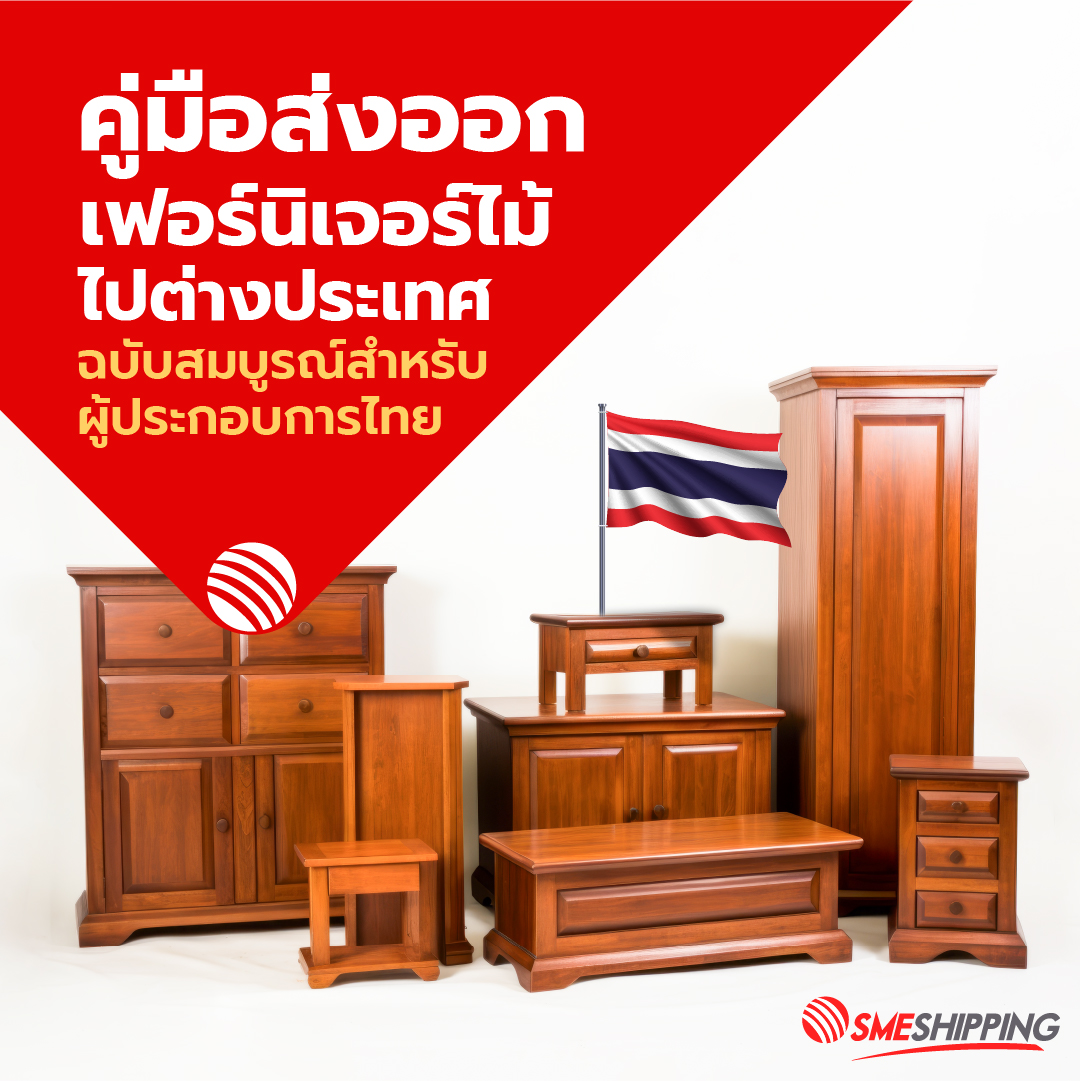
A Complete Guide to Exporting Wooden Furniture
1. Overview of the Wooden Furniture Export Market: Opportunities and Challenges for Thai Entrepreneurs.
The Thai wooden furniture industry is considered one of the industries with international potential, thanks to its high-quality wood raw materials, exquisite craftsmanship, and unique Thai designs, which have earned the products a strong reputation.“wooden furniture”"In the global market, therefore, the..."“Exporting furniture”"Therefore, it has become a significant opportunity for Thai entrepreneurs to generate revenue and expand their brands."“Export to foreign countries”"sustainably"
However, exporting wooden furniture presents not only opportunities but also several challenges, including strict international regulations, product standards, environmental hygiene, and more.“Export requirements for wooden furniture.”"Regarding the documents and..."“Customs procedures”"These procedures must be strictly followed. Therefore, this guide will help Thai entrepreneurs understand the steps involved."“Exporting wooden furniture.”"Systematic approach increases the chances of success on the global stage."
1.1 Overview of the Thai Wooden Furniture Market
- Outstanding quality and design.Thai wooden furniture is known for its craftsmanship and durability, as it uses rubberwood, teak, or other certified woods.
- High demand from the global market.The European Union, the United States, China, and the Middle East have a demand for wooden furniture for decorating homes, offices, and hotels.
- Adapting to the eco-friendly trend.Currently, the world places great importance on "Green Products"—products manufactured responsibly in the environment. Thai wooden furniture certified under the Sustainable Forestry Council (FSC) or Professional Forestry Cooperative (PEFC) standard is therefore showing continuous growth.
1.2 Opportunities and Challenges
- chance
- Wooden furniture export market Continued growth: With the expansion of the real estate and interior design industries, the demand for furniture is increasing in many countries.
- Thailand's export promotion policyThe Thai government provides support through various programs, including loans and participation in international trade fairs, to expand into overseas markets.
- Innovative manufacturing and design.Entrepreneurs can leverage new technologies or designs to add value and differentiate their products.
- Challenges
- fierce competitionFrom major producers in the global market, such as China, Vietnam, and Indonesia, which have low production costs.
- Export requirements for wooden furniture. Environmental and health aspects: For example, certifying legal wood or adhering to sustainable forestry standards, which can sometimes involve significant inspection and certification costs.
- exchange rateThe volatility of the Thai baht may force exporters to manage costs and profits carefully.
With these opportunities and challenges, entrepreneurs need to study the steps involved.“Exporting wooden furniture.”"To provide comprehensive coverage in order to reduce risks and enhance international competitiveness."
2. Procedures for exporting wooden furniture.
process "“Exporting wooden furniture.”"There are many steps involved, from preparation to receiving payment for goods. Systematic planning can reduce errors and increase the chances of success in international markets."
2.1 Initial preparations
- Study and analyze the target market.
- Explore consumer needs in each country, such as style, design, size, popular materials, and special requirements (if any).
- Analyze competitors in terms of price, quality, and marketing strategies.
- Planning production and designing products.
- Design and manufacture products that meet the tastes of the target market.
- Calculate the costs of production, raw materials, labor, and transportation, and determine an appropriate price.
- Prepare environmental standards and certifications (if required).
- Some countries require FSC or PEFC certification to confirm that the timber used does not contribute to deforestation.
- For indoor wooden furniture, some manufacturers may require certifications regarding surface coatings and VOCs (Volatile Organic Compounds).
2.2 Finding customers and making contracts.
- Find customers overseas.
- Participate in international furniture fairs, both in Thailand and abroad.
- Register on a B2B platform such as Alibaba or Global Sources, or participate in business matching events.
- Contact through the Thai Furniture Exporters Association network or government agencies such as: Department of International Trade Promotion (DITP)
- Contract and trade terms.
- Agree on the quantity of goods, price, shipping method, delivery time, and payment terms.
- Plan and select appropriate international trade terms (Incoterms), such as EXW, FOB, CIF, etc.
2.3 Application for an Export License for Wooden Furniture
- Wooden furniture export license From the Department of International Trade (if required by law).
- Businesses must check the regulations to see whether the type of furniture they are exporting requires a license.
- Sometimes additional documents may be required, such as a Legal Wood Certificate.
2.4 Preparing documents for exporting wooden furniture.
Preparing the "Documents for Exporting Wooden Furniture" is extremely important. To smoothly complete customs procedures both domestically and at the destination country, the main documents required are as follows:
- Commercial Invoice
- Specify seller and buyer information, product details, quantity, price, and terms of sale.
- Packing List
- Specify packaging information such as weight, number of boxes, and volume for inspection during transit.
- Bill of Lading (B/L) or Airway Bill (AWB)
- Shipping documents for sea or air freight serve as proof of shipment and authorize the consignee to collect the goods.
- Certificate of Origin
- Issued by organizations such as the Chamber of Commerce to confirm that the furniture is manufactured in Thailand, this could help reduce import tariffs if an FTA agreement is in place.
- Safety and environmental documentation (if applicable)
- For example, certificates such as FSC, PEFC, REACH, or others as required by the importing country.
- Phytosanitary Certificate (if raw wood is used, or as per requirements of the destination country)
- Some countries require phytosanitary certificates for wood products to reduce the risk of pests or fungi that may be present in the wood.
2.5 Transportation Management and Customs Procedures
- Choosing a transportation method.
- By boatSuitable for large items and for those seeking cost-effectiveness, but it takes a long time.
- By airSuitable for products that require fast delivery but have higher costs.
- Multimodal TransportCombining multiple modes of transportation, such as road + sea or road + air.
- Customs procedures
- Submit the export declaration to the Customs Department electronically (paperless).
- Please attach all required documents as specified by the Customs Department, such as Commercial Invoice, Packing List, and wooden furniture export license (if applicable).
- Pay customs fees, taxes, or other service charges (if any).
2.6 Receiving payment for goods.
- Payment terms
- Letter of Credit (L/C): The bank acts as an intermediary in the payment process, providing security for both the buyer and the seller.
- Telegraphic Transfer (T/T): Electronic bank transfer, widely used.
- Documents against Payment (D/P): The buyer will receive the product documents upon payment according to the terms of the transaction.
- Tracking and verifying payments.
- Exporters must retain complete proof of money transfer for future verification or for use as collateral for loans.
3. Relevant important documents.
In addition to documents involved in the transportation process, there are also legal documents and various standards that businesses should pay attention to.
- Wooden furniture export license
- You should check with... Department of International Trade Whether the type of goods being shipped requires a license or not.
- Commercial Invoice
- It is used as proof of trade and is required for customs clearance.
- Certificate of Origin
- This could help reduce tariffs under various free trade agreements (FTAs), making Thai products more competitive in the global market.
- Phytosanitary Certificate
- If it's wooden furniture that still shows the wood's natural texture, or uses materials that may pose a risk of spreading plant diseases or insects.
- Environmental Standard Certificate
- For furniture exported to markets with strict environmental regulations, such as the European Union, REACH or RoHS certification may be required in some cases.
4. Laws and Regulations: Product standards, environmental requirements.
action "“Export to foreign countries”"Regarding wooden furniture, there are various regulations involved, both in Thailand and the importing country. Businesses should be aware of and strictly adhere to them to avoid product rejection or incurring additional costs."
- Thai Customs Law
- Exporters must submit documents through the customs system correctly and pay any fees (if applicable) as required by law.
- Forestry and timber laws.
- If the product uses domestically sourced wood that requires special permits for logging or processing, the wood's origin standards must be checked, such as whether it is legally sourced (Legal Wood).
- Product standards and environmental requirements.
- Some countries may require products to pass formaldehyde emission tests or tests for other volatile substances.
- Eco-labels may increase opportunities to market to environmentally conscious consumers.
- Regulations of the importing country.
- Each country has different regulations regarding the import of wood products.
- You can check the latest regulations from official sources, such as: onestopservice.ditp.go.th or Customs Department
5. Preparation before export.
To ensure a smooth export process, businesses should prepare for production, packaging, transportation, and insurance as follows:
5.1 Designing and manufacturing furniture to meet international standards.
- Choose wood materials that meet standards.An environmental certificate or confirmation of legal logging sources is required.
- Designed to meet market demands.Understanding consumer preferences in style, color, and size to meet their needs.
- Control costsFind ways to reduce costs in production, material usage, and labor management without compromising product quality.
5.2 Quality Control
- Establish quality control (QC) standards at every stage.From wood selection and processing to assembly, coating, and packaging.
- Test for strength and safety.Especially furniture such as tables, chairs, and beds that must be able to support weight or comply with international standards (e.g., EN, BIFMA).
5.3 Packaging
- Choose packaging materials that protect the product.To ensure the goods are safe during transport, without breakage or scratches.
- Use legally sourced packaging materials.For example, heat-treated wooden pallets, which some countries require to have the IPPC (International Plant Protection Convention) mark.
5.4 Choosing a transportation method.
- By boatCommonly used for large or numerous pieces of wooden furniture. It is less expensive but takes longer to produce.
- By airUsed for products requiring fast delivery or product samples, but where shipping costs are high.
- Coordinating with freight forwarders.We can professionally handle container shipments, cargo arrangements, and documentation.
5.5 Insurance
- Purchase cargo insurance.Covers damage or loss of goods due to accidents or other factors.
- Choose the appropriate type of insurance.For example, Institute Cargo Clauses (A), (B), (C) to cover the risks of the route and the value of the goods.
6. Tips for Wooden Furniture Exporters
Being “Wooden furniture exporters”"Success is not just about producing quality products, but also about having appropriate planning and strategic adjustments."
- In-depth market analysis
- Study the details of consumer behavior, regulations, and import tariffs in each country.
- Assess the market potential; for example, countries with strict environmental regulations or low import taxes might be good targets.
- Create a brand and identity.
- Develop brand storytelling, such as using sustainably sourced wood and designing to reflect Thai art.
- Communicate your unique selling points to international markets through social media, websites, or B2B platforms.
- Negotiate strategically.
- Study the business partners and business culture of the target country.
- Establish payment and delivery terms that are mutually beneficial to both parties.
- Risk management
- Consider currency hedging if you make large payments in foreign currencies.
- Plan inventory management and diversify export markets to reduce over-reliance on any single market.
- Keep up to date with new laws and standards.
- Many countries are continuously updating their environmental and sanitary laws, so exporters must stay informed.
- Join the Thai Furniture Industry Association or the Furniture Exporters Association to receive the latest information.
7. Conclusion
action "“Exporting wooden furniture.”"Going abroad presents a promising opportunity for Thai entrepreneurs, as Thai wood and designs possess unique characteristics and quality that are recognized in the international market. However, in doing so..."“Exporting furniture”"The following factors must be taken into consideration:"
- Conduct a thorough market study.From customer needs, regulations, and tax policies to design trends.
- Strictly adhere to the "Wooden Furniture Export Requirements".This includes all necessary documentation, licenses, and environmental standards to ensure a smooth "customs clearance" process.
- Preparing for production.Quality control, product design tailored to target market preferences, and standardized packaging.
- Plan the marketing and financial strategies.Focus on brand building, managing exchange rate risk, and setting appropriate payment terms.
- Continuous adaptation.Because environmental laws and standards may change at any time.
When entrepreneurs have the knowledge and preparation at every stage, their chances of succeeding in international markets increase. Thai wooden furniture can be exported worldwide, generating sustainable revenue and reputation for Thailand.
Reliable sources of information.
- Department of Foreign Trade
- Thai Customs
- Department of International Trade Promotion (DITP)
- Thai Furniture Exporters Association
- Thai Furniture Industry Association
Hopefully, this article will be useful to Thai wooden furniture entrepreneurs who wish to enter the "export market."“
Thorough preparation, from production to documentation and customs clearance, will ensure the stable and sustainable growth of Thai wooden furniture on the global stage.





 English
  Thai
Thai